
Straight Leg Raise Exercise: Benefits, Technique & Common Mistakes
What is a Straight Leg Raise Exercise?
The Straight Leg Raise Exercise is a simple and effective exercise that helps strengthen the quadriceps, hip flexors, and core muscles without putting excessive stress on the knee joint. It is commonly recommended in physiotherapy for improving leg strength, knee stability, and mobility during rehabilitation after injuries or surgery.
Additionally, it enhances hip joint range of motion and flexibility.
What muscles do straight leg raises work?
Straight leg raising exercises mainly work the hip and thigh muscles, such as:
Rectus femoris, vastus lateralis, vastus medialis, and vastus intermedius are the four muscles that make up the quadriceps, a group of muscles on the front of the thigh. Walking, sprinting, jumping, climbing stairs, squatting to pick something up off the ground, and kicking a ball are all made possible by these muscles, which stretch the knee joint.
Hip flexors: At the front of the hip are the hip flexor muscles, which include the rectus femoris and iliopsoas. When you perform activities like climbing stairs, sitting or standing in a chair, putting on socks and shoes, and stepping over barriers on the ground in front of you, they are activated and aid with hip flexion.
Along with other lower body muscles like the glutes (buttocks) and hamstrings (back of the thigh), your abdominal and core muscles are also used during the straight leg raise, albeit to a lesser degree.
Benefits of Straight Leg Raises
- Strengthens the Lower Abs: One of the few exercises that specifically target the lower part of the rectus abdominis, which most individuals find difficult to engage, is the leg raise. Over time, consistent practice increases this area’s functional strength and visible definition.
- Improves Hip Flexor Strength: Walking, running, and climbing stairs are all controlled by your hip flexors. Leg lifts gradually increase the strength and resiliency of these muscles by putting them through their whole range of motion. Additionally, lower-back pain during daily tasks is less likely when hip flexors are stronger. Stronger hip flexors are a fantastic starting point if you wish to enhance this with improved running performance.
- Builds Core Stability: Your torso must remain supported and motionless during each leg raise repetition. Your transverse abdominis and multifidus, two deep stabilizing muscles, will eventually learn to fire on their own, enhancing your posture and balance all day.
- Lessens Lower-Back discomfort: One of the main causes of lower-back pain is a weak core. Leg raises can help you maintain better spinal alignment while sitting or standing for lengthy periods of time by strengthening the muscles that support your lumbar spine.
- Promotes Fat Loss When Combined with Cardio: Leg raises increase total calorie expenditure and muscular growth, but no single exercise specifically targets fat in one location. They facilitate a gradual alteration in body composition when combined with a regular cardio and strength regimen. See this advice on using structured training to lose abdominal fat for a more comprehensive strategy.
- Requires No Equipment: All you need is a level surface. Leg raises are therefore among the easiest core exercises to perform, making them ideal for at-home workouts at any time of day.
- Adaptable for All Fitness Levels: This exercise simply ranges from weighted straight leg lifts for advanced trainers to bent-knee variations for novices. Without ever using a machine, you can advance at your own speed.
How to perform a straight leg raise?
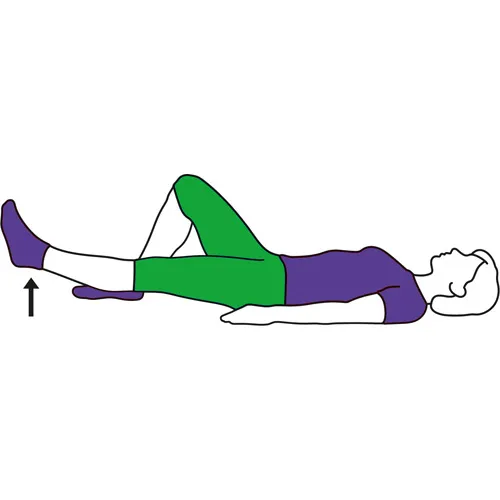
- With one leg straight on the floor and the other bent at the knee (with your foot flat on the ground), lie on your back.
- Maintain a straight ceiling straight ceiling straight ceiling.
- Hold your leg for a few seconds, then let go and put it back on the ground.
- Since each person is unique, you might need to adapt the straight leg raise to suit your demands.
To make straight leg raises easier:
- Limit the distance you raise your leg toward the ceiling to reduce your range of motion.
- Place your hands on a table for support and begin standing. Next, keep your leg straight as you raise one leg toward the ceiling.
To make straight leg raises harder:
- To increase resistance, wrap a band across your knees.
- For a longer period of time, keep your leg raised.
- To make the exercise easier or harder, you can use one of the aforementioned adjustments, or you can use many at once.
Common Mistakes to Avoid
- The typical mistake is the lower back arch mistake. The lower back arches away from the floor to compensate for weak or tired hip flexors, transferring weight from the core to the lumbar spine. Before lifting, firmly press your lower back into the mat; if the arch reappears, discontinue the exercise. It’s always better to use the bent-knee variation or limit your range of motion than to push through bad form.
- Ignoring the Warm-Up: A stiff lumbar spine and cold hip flexors can lead to injuries. Before your first set, spend three to five minutes performing dynamic warm-up exercises like cat-cow stretches, hip circles, and glute bridges. This significantly lowers the chance of strain.
- Using Momentum Rather than Muscle: By rapidly raising and lowering your legs, you avoid using the muscles you are attempting to strengthen. Aim for a lift of two seconds and a drop of three seconds. The majority of the actual strength adaptation occurs during the eccentric (lowering) phase.
- Inconsistency: A lot of people perform intense leg lifts for a week before pausing for two. Core strength reacts to consistent, gradual stimuli rather than sporadic spikes. Daily sessions for ten days followed by a month of rest will be outperformed by three regular sessions per week for eight weeks. The factor that distinguishes individuals who experience results from those who do not is consistency.
Conclusion:
Without bending the knee joint, the straight leg lift exercise aggressively develops the hip flexors (iliopsoas) and quadriceps (rectus femoris).
FAQs
What is the correct technique for straight leg raises?
Lying on your back with one leg bent and the other straight, contract your thigh muscles and raise the straight leg 6 to 12 inches off the ground are the safe and proper ways to complete a straight leg raise.
What would happen if you performed daily leg raises?
Daily leg raises can build hip flexor strength and core endurance, but the lack of recovery time increases the risk of overuse problems and lower back strain.
What are the benefits of doing a straight leg raise?
Straight leg raises improve knee and core stability without putting undue strain on the knee joint while strengthening your quadriceps (front thigh muscles) and hip flexors.
What are common mistakes in leg raises?
Arching the lower back off the floor or pad during leg lifts is the most frequent and hazardous error, which transfers the strain from your abs to your spine and raises the chance of injury.
References:
- Bothra, T. (2026, September 19). How to do leg raises: Benefits, form & mistakes. Habuild. https://habuild.in/habitology/strength-and-fitness/how-to-do-leg-raises
- (n.d.). straight-leg-raise-slr-exercise. samarpanphysioclinic.com. https://samarpanphysioclinic.com/straight-leg-raise-slr-exercise/
- Dpt, D. P. P. (2026, July 23). Straight leg raise: How to do it, benefits, and variations. Hinge Health. https://www.hingehealth.com/resources/articles/straight-leg-raise/
- Luijkx, R., & Luijkx, R. (2026, April 16). Straight leg raise – Physio Vital Exercise. Fysio Fitaal. https://fysiofitaal.nl/en/exercise/straight-leg-raise/