Slipped Disc
Introduction
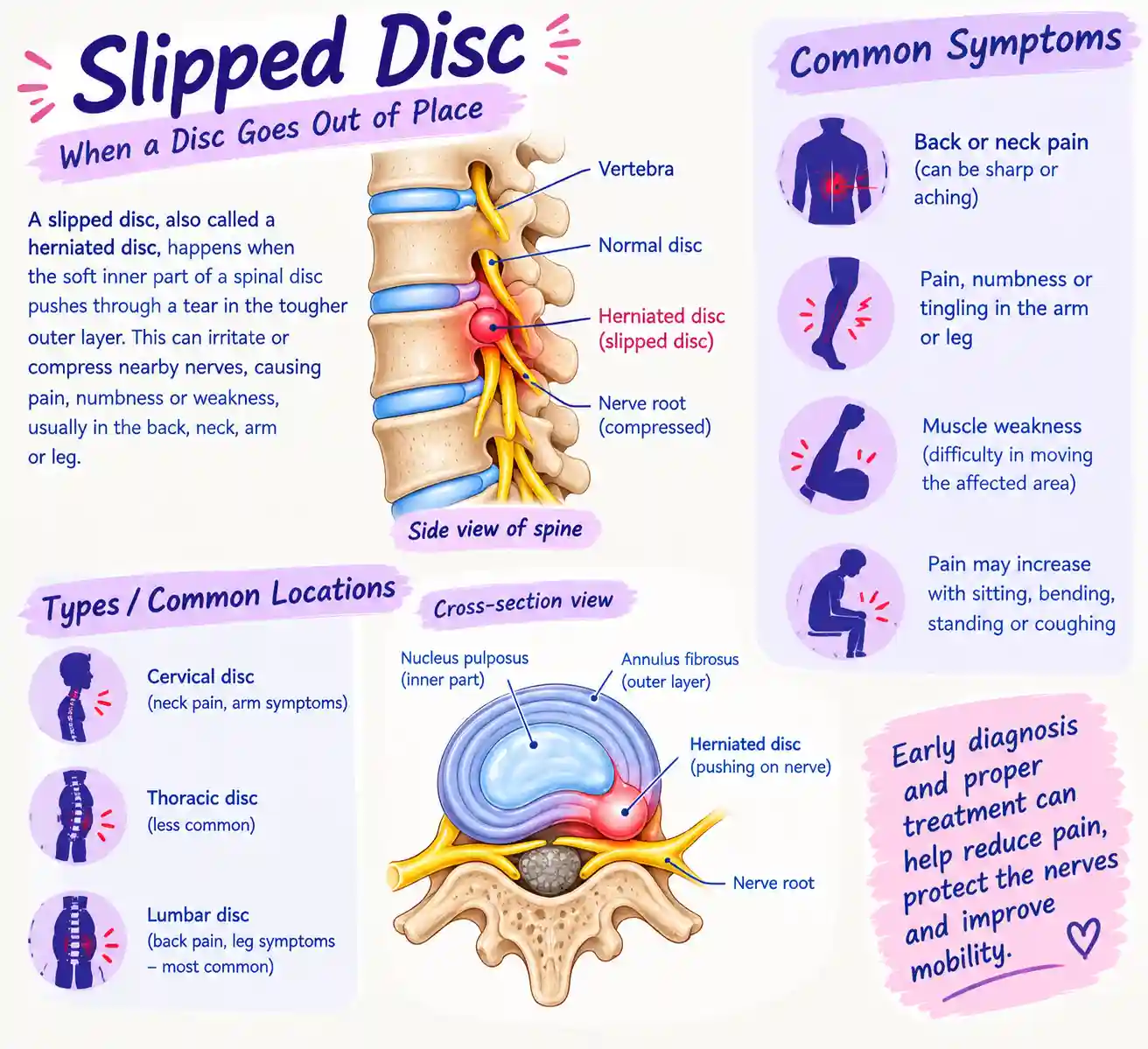
A Slipped Disc, also known as a herniated or prolapsed disc, is a condition in which the soft inner material of a spinal disc pushes through a weakened or damaged outer layer. Slipped discs most commonly occur in the lower back, although they can also affect the neck.
The spine is made up of vertebrae separated by flexible discs that help absorb shock and allow movement. Age-related changes, repeated strain, improper lifting, sudden movements, and certain injuries can increase the risk of disc problems. Some people may have back or neck pain, while others may experience pain that travels into the leg or arm.
Early assessment and appropriate management can help control symptoms and support recovery. Treatment is usually based on the severity of symptoms and may include activity modification, physiotherapy, exercises, medication, and other medical treatments when necessary.
What are the symptoms of a slipped disc?
Although it usually occurs in the lower back, a herniated disc can also occur in the neck. The location of the disk and whether it is pushing on an adjacent nerve determine the symptoms. A herniated disk typically only affects one side of the body.
Pain in the arms or legs. Lower back, buttocks, thigh, and calf pain can be caused by a herniated disk. It could also result in foot pain.
When you laugh, cough, sneeze, or move in a particular way, you could experience searing or intense pain that grows worse.
Tingling or numbness. In the part of the body where the inflamed nerve is located, a herniated disk may result in radiating tingling or numbness.
weakness. Weakness may develop in the muscles connected to the affected nerve. You may feel unstable when walking, have difficulty lifting, or drop objects.
Some people may not even be aware that they have a herniated disk until an imaging test reveals it.
What causes slipped discs?
Because disks naturally deteriorate with age, a herniated disk usually develops over time. The disks in your spine grow less flexible as you age, making them more prone to tearing or rupturing from even little motions like bending or twisting.
Most of the time, people are unaware of the cause of their herniated disk. A herniated disk can occasionally result from lifting heavy objects with your back muscles rather than your leg and thigh muscles. A herniated disk can also result from twisting and rotating while lifting. Rarely, a fall or a blow to the back may be the reason.
Risk Factors of Slipped Disc
- Excess bodily weight. Excessive weight puts additional strain on the lower back’s disks.
- Physically hard work. A herniated disk is more likely to occur in jobs that require lifting, tugging, pushing, bending, or twisting.
- Ancestry. A higher risk of developing a herniated disk is inherited by certain individuals.
- Smoking. Smoking may reduce blood supply to the spinal disks, accelerating their deterioration.
- Driving a lot. Long stretches of sitting mixed with the vibration of a car engine can strain the spine.
- Not exercising. Maintaining an active lifestyle may help prevent a herniated disc and protect your back.
How are slipped discs diagnosed?
- X-rays
- CT scans
- MRI scans
- discograms
Treatment Of Slipped Disc
Many people can be managed with conservative treatment. Physiotherapy may focus on maintaining appropriate spinal movement, improving flexibility, strengthening the trunk and supporting muscles, and gradually returning to normal activities.
Gentle, regular movement is generally preferable to complete inactivity, provided it does not significantly worsen symptoms.
Medical Treatment Of Slipped Disc
A healthcare professional may recommend appropriate pain-relieving or anti-inflammatory medicines. Depending on the symptoms, muscle-relaxing medication or other treatments may sometimes be considered. Physiotherapy may be prescribed to improve mobility, strength, posture, and functional movement.
Persistent nerve-related symptoms may require further assessment and imaging such as MRI. In selected cases with severe or persistent symptoms, nerve-related complications, or failure of conservative treatment, specialist procedures or surgery may be considered.
Physiotherapy treatment of Slipped Disc
Exercise for Slipped Disc
Seated chair stretch
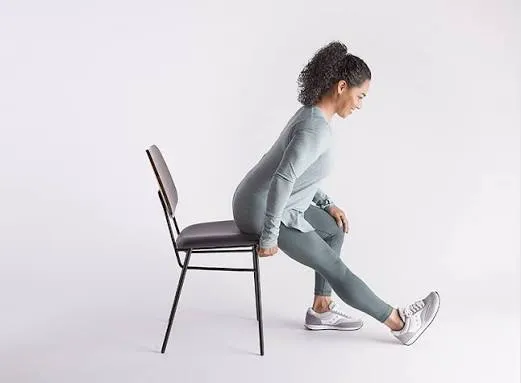
- Sit on the chair.
- Straighten your leg and hold for 30 seconds.
- For five to ten seconds, maintain this posture.
Repeat many rounds, switching legs.
Lying hamstring stretch
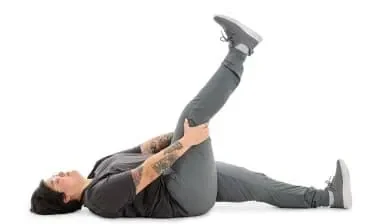
One can attempt the following as an additional hamstring stretch:
- Lie on the floor or mat and stretch your leg with your hands.
- Alternatively, encircle the hamstring with a towel, holding one end in each hand.
- Pull the leg gently toward the direction of the body.
- For 30 to 60 seconds, hold.
- Repeat many rounds, switching legs.
Knee to chest stretch
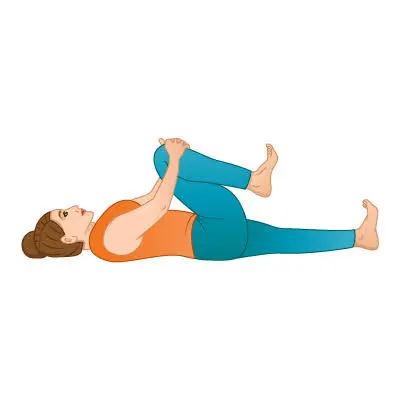
- For a more moderate stretch, the knee-to-chest stretch works the muscles on both sides of the body independently. Try the following:
- Grasp your knee with your hand and pull it towards you.
For 15 to 20 seconds, hold the stretch.
Repeat many rounds, switching legs.
Piriformis muscle stretch
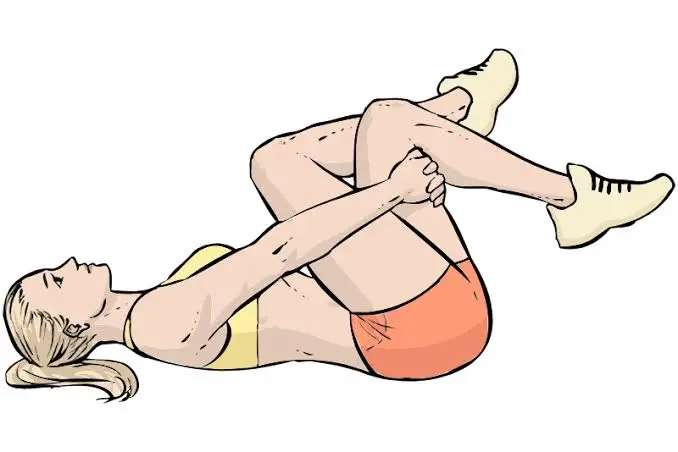
- Deep in the buttocks is a small muscle called the piriformis. To stretch this muscle:
- Put your hands on the back of your thigh and pull gently.
- With the ankle resting on the bent knee, cross one leg over the other.
- Pull the crossed knee gently toward the chest until the buttocks are stretched.
- For 15 to 30 seconds, hold the stretch.
- Continue on both sides.
Home Remedies for a Slipped Disc
For mild symptoms, temporarily reduce activities that increase pain while maintaining gentle movement as tolerated. Applying a cold pack wrapped in a towel may help with acute discomfort, while heat may provide temporary relief for muscle stiffness or spasm.
Avoid prolonged sitting or lying in one position. Take short movement breaks and change positions regularly. Gentle walking may help maintain mobility if it does not increase symptoms. Use a comfortable sleeping position and avoid movements that cause sudden or severe pain.
Ergonomic Care of a Slipped Disc
Maintain a comfortable posture during sitting, standing, and working. Use a supportive chair and keep your feet comfortably supported when sitting. Position computer screens and keyboards at suitable heights to avoid prolonged awkward postures.
When lifting objects, bend through the hips and knees and keep the object close to your body. Avoid twisting while lifting and do not suddenly lift heavy loads. Take regular breaks during prolonged sitting and gently change your position.
Prevention Of Slipped Disc
Regular physical activity and strengthening of the abdominal, back, hip, and leg muscles can help support the spine. Include appropriate flexibility exercises and gradually increase exercise intensity rather than making sudden changes.
Maintain a healthy body weight, use proper lifting techniques, and avoid repetitive movements that consistently aggravate your back. Warm up before strenuous activities and use appropriate techniques during sports and exercise.
Avoid prolonged inactivity and maintain good posture during daily activities. If you develop chronic back pain, progressive weakness, significant numbness, or difficulty controlling bladder or bowel function, seek medical attention promptly.
Complications Of Slipped Disc
Your spinal cord stops just above your waist. A bundle of nerves continues down the spinal canal below that. Because of its appearance, this bundle is known as the cauda equina, which translates to “horse’s tail” in Latin.
In rare cases, the entire bundle of nerves in this region may be compressed by a herniated disk. This is an urgent medical situation. You can get permanent weakness or perhaps paralysis if you don’t get treatment right away. To avoid severe, long-term harm, emergency surgery might be required.
Get medical help right away if you have:
- Symptoms getting worse. Weakness, numbness, or pain that worsens and makes daily tasks difficult.
- Bowel or bladder problems. Difficulty peeing even when your bladder feels full, or difficulty holding stool or urine.
- Saddle anesthesia. Numbness or loss of feeling in the parts of the body that would come into contact with a saddle, like the rectum, backs of the legs, and inner thighs.
FAQs
How do you fix a slipped disc?
You can heal a slipped disc with the help of methods like over-the-counter medications, gentle movements, and physiotherapy, as the condition improves naturally in several weeks.
Home Remedies and Medication
Use pain medicines: Use over-the-counter medicine for pain relief, such as ibuprofen or naproxen.
Use hot and cold packs: Use a cold pack at the onset of inflammation and apply heated pads to the affected area afterward to ease muscle tightness.
Stay active: Avoid lying in bed for long hours; stay active by taking short walks and doing light chores.
How long does a slipped disc last?
A herniated (slipped) disc typically causes debilitating pain, which starts to improve within a period of 4 to 6 weeks, while most patients almost fully recover from pain within a period of 3 months.
Traditional Healing Timeline
1-2 weeks (Acute Stage): This is the point when inflammation and sharp or radiating pain are at their worst.
2 – 6 weeks (Improvement Stage): Pain and the incidence of muscle spasms start to decline noticeably, and normal movement is beginning to be restored.
6 weeks – 3 months (Healing Stage): The body has started absorbing herniated disc material, and ordinary activities can be resumed by the patient.
3 – 6 months (Long-Term Recovery): In extreme cases, full recovery may take up to half a year.
Is a slipped disc serious?
A slipped disc is not a severe condition and typically heals in four to six weeks with rest, physical therapy, and anti-inflammatory medication.
When It Becomes Serious
A slipped disc becomes serious when it exerts pressure on a nerve or the spinal cord.
Nerve pressure: This leads to prolonged muscle weakness, numbness in the arms or legs, or persistent pain.
Cauda equina syndrome: This is an extremely rare situation in which the disc presses on a nerve cluster at the spine’s base and requires surgery to prevent irreparable harm.
Emergency Signs
You should rush to the hospital if you experience any of the following symptoms in addition to a slipped disc:
Inability to control your bowels and bladder
Numbness in the groin area, inner thighs, or around the bottom (saddle anesthesia)
Sudden or worsening leg weakness that makes standing and walking difficult.
Is bed rest good for slipped discs?
Bed rest is not recommended for people with a herniated disc. Although 1-2 days of rest may reduce pain, prolonged inactivity will only lead to weak muscles and a longer healing process.
Why Prolonged Bed Rest is Dangerous
Muscle Weakness: When you stay in bed, your back and core muscles will weaken.
Increased Stiffness: When you do not move, your joints will become stiff, increasing pain upon moving again.
Slowed Healing: Sitting in bed reduces blood circulation, which in turn cuts off the nutrients needed for healing.
Ways to Take Care of Your Herniated Disc
Short Rest Periods: Lying in bed no more than 1 or 2 days during acute episodes.
Gentle Movement: Walking daily for brief periods of time (5-10 min) will help keep blood circulation and flexibility.
Proper Posture: Avoid bending, twisting, and heavy lifting.
Professional Help: Use a recovery plan from a specialist.
Is walking ok for a slipped disc?
According to experts, walking may be an effective form of exercise for healing a herniated disc. Going for a walk has several advantages, particularly the following ones:
– Improves blood circulation, which helps the damaged area to recover.
– Helps with stiffness and tightness.
– Involves muscles of the core, enabling them to better support the spinal column and its discs.
While there is no definitive answer to the question about the best distance or pace, it is generally accepted that taking short walks frequently has a positive effect on recovery, but excessive walking may lead to swelling or discomfort.
Advice on Walking witha Herniated Disc:
– Start gradually: Begin with a short walk lasting 5-10 minutes and gradually increase the duration of the walk.
– Maintain a good posture: Keep the back straight, the shoulders relaxed, and the chin up while walking.
– Make shorter steps: Avoid taking long steps that may irritate the sciatic nerve.
– Walk on flat ground: Avoid hilly, steep,p or uneven terrain.
– Wear comfortable shoes: Choose flat shoes that provide enough cushioning and arch support.
– Stop in case of pain: If you feel sharp pain or numbness radiating down your leg, stop and rest.
What are the first signs of a slipped disc?
The first sign of a slipped (herniated) disc is often persistent local pain in the lower back or neck that may be experienced as sharp, dull, or burning.
Early Warning Signs
Localized Pain: Deep sensation in the spine or sharp pain that persists despite rest.
Radiating Pain (Sciatica): Sharp or burning pain spreading from the lower back to the buttocks and legs and down the arm if the condition is in the neck.
Tingling or Numbness: A “pins and needles” feeling in the shoulders, arms, legs, or feet due to pressure on nearby nerves.
Pain with Movement: Discomfort increases with bending forward and twisting, prolonged sitting, coughing, and sneezing.
Muscle Weakness: You may experience difficulty in foot raising, pinching and holding objects, or maintaining balance due to interference with nerve signaling.
Can a slipped disc correct itself?
It is true that the majority of herniated discs can heal by themselves in 70-90% of cases within 6-12 weeks.
How the Body Recovers from a Herniated Disc
Disappearing bulging: The process involves the body’s immune cells (macrophages) that will gradually dissolve and absorb the disc material that gets leaked.
Lessening inflammation: Disappearing swelling near the affected nerve allows pain signals to stop.
Retracting naturally: In some instances, the bulging part of a disc will go back to the proper position in the disc space.
What Should Be Done to Recover Thoroughly
Keep active in moderation: Although doing heavy lifting and bending is a must, it is recommended to do some walking instead of resting in bed.
Alternate cold and hot treatments: During the first couple of days, some ice packs should be used to relieve the swelling, while later on turning to hot treatment to relax muscles.
Engage in physical therapy: The help of specialists in physical exercise allows strengthening muscles that support the spine, thus relieving the pressure.
Take medications: Over-the-counter anti-inflammatory medications (like ibuprofen) should be used to cope with pain.
References
- Barrell, A. (2026, April 17). 6 safe exercises for a herniated disk. htps://www.medicalnewstoday.com/articles/324311
- Best exercises for herniated disc: 9 safe moves to strengthen and heal your spine. (n.d.). https://www.bswhealth.com/blog/best-exercises-for-herniated-disc
- Blog details | Metropolis Healthcare. (n.d.). Metropolis Healthcare. https://www.metropolisindia.com/blog/preventive-healthcare/slipped-disc-exercises-for-pain-relief-and-treatment
- Crna, R. N. M. (2023, March 15). Slipped (Herniated) disc. Healthline. https://www.healthline.com/health/herniated-disk
- Herniated disk (Slipped or bulging disk). (2026, April 6). Cleveland Clinic. https://my.clevelandclinic.org/health/diseases/12768-herniated-disk
- McQuilkie, S., DC, & McQuilkie, S., DC. (2023, July 3). 7 Herniated disc exercises & stretches for lower back. Back Intelligence (Creators of PostureFlow App). https://backintelligence.com/herniated-disc-exercises/
- Raut, S. (2025a, November 20). Slipped Disc: Causes, Symptoms, Treatment & Full Recovery Guide. One Spine. https://onespine.co.in/blog/slipped-disc-causes-symptoms-treatment/
- WebMD Editorial Team. (2025, July 22). Slipped disk: Exercises for pain relief. WebMD. https://www.webmd.com/back-pain/slipped-disc-exercises-for-pain-relief
- Website, N. (2026, May 6). Slipped disc. nhs.uk. https://www.nhs.uk/conditions/slipped-disc/