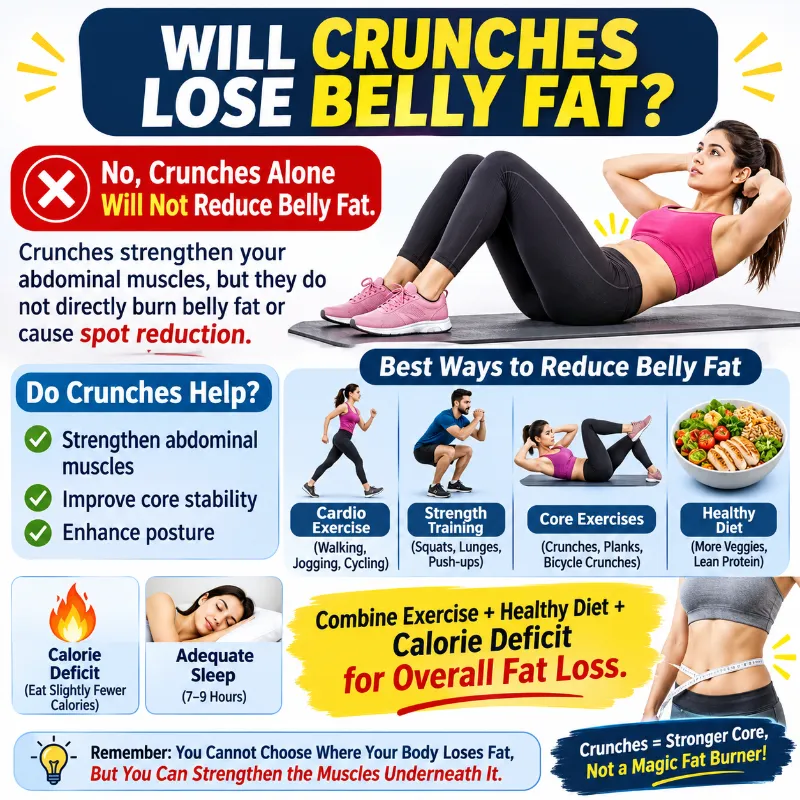
Do Crunches Burn Belly Fat? What Actually Works
Actually No.
Although performing crunches will strengthen the muscles in your stomach area, they will not specifically target fat stored around these muscles. Overall body fat reduction will occur based largely on your dietary intake and physical activity throughout the week. While crunches may be included in this, it is good to know what they can and cannot do.
Fat reduction
Many people believe that targeting a particular muscle group will result in fat loss in that area (spot reduction). However, research does not support this. In a popular study, participants performed sit-ups for 6 weeks; however, minimal fat loss occurred in the abdominal region in comparison to the rest of the body.
Maintaining a calorie deficit encourages the body to use stored fat from different areas, resulting in overall fat loss. This order depends on genetics, gender, and hormones. Some people will lose fat from the face or hips first, and for many people, fat will be lost from the abdomen last.
The abdomen contains two primary forms of fat: subcutaneous fat and visceral fat. Subcutaneous fat can be pinched from under the skin. Visceral fat wraps around the liver and intestine. Visceral fat is associated with developing type 2 diabetes, high blood pressure, and heart problems.
Abdominal crunches help develop core strength, but they cannot selectively reduce subcutaneous belly fat or visceral fat surrounding the organs. However, regular cardiovascular exercise, modest calorie deficits, sufficient sleep, and managing stress can. Visceral fat appears to respond quite well to exercise.
Muscles worked
Crunches involve a small curl motion in the upper body, with knees bent. The main muscle being targeted is the rectus abdominis. This long flat muscle extends from your lower ribs to your pubic bone. When body fat is reduced sufficiently, you can see this muscle, forming visible ‘six-pack’ muscles.
The external and internal oblique muscles (on the sides of the trunk) are also worked, along with the transverse abdominus (a deep muscle surrounding the waist). This provides stability to the trunk. The hip flexor muscles also play a minor role in performing a good crunch. However, in a full sit-up, in which the whole torso lifts off the floor, the hip flexors become much more active.
Common misconceptions
Crunches do not strengthen the lower back muscles. The extensor muscles of the back are not worked in this exercise. For strengthening these muscles, perform ‘bird dogs’ or back extensions. It is a common misconception that there are upper and lower ab muscles.
The rectus abdominis is a single muscle. Even if a movement feels to be targeting one region more, it is not possible to target specific areas of this muscle.
Benefits of Crunches
Crunches improve strength and stamina in flexor muscles of the trunk. This allows you to sit up from lying down and lift objects from the floor. With continued practice, the muscle can increase in size. Whether this becomes visible depends on the fat covering it. As very few calories are burned in a set of crunches, they will only contribute significantly to calorie burn if performed as part of a longer session including cardio and resistance exercises.
Crunches may be claimed to improve posture and ease back pain; however, there is limited evidence supporting this. Although having strong trunk muscles can support the spine, good posture relies on mobility in the hips and shoulders, as well as how long you sit for and how you move throughout the rest of the day. Crunches will not increase flexibility.
Crunches Video
How to perform?
- Lie on your back with knees bent and feet flat on the floor. Knees should be hip distance apart.
- Place fingers gently behind ears or cross arms. Avoid linking fingers behind the head as this can cause strain in the neck.
- Engage your deep stomach muscles by ‘sucking in’ your stomach just below the navel.
- Exhale and lift your head, neck and top back. Your shoulder blades should just leave the floor. Only move a small amount. Moving further up will largely engage the hip flexor muscles.
- Hold for one second, then slowly return to the start position as you inhale.
Common mistakes include using momentum from arms, straining the neck, holding breath, returning too quickly, and lifting hips/heels. If you begin to tire in the neck before the stomach, tuck your chin in slightly (as if you have a small orange in your mouth) and slow down.
Number of repetitions
As a beginner, doing 2-3 sessions a week, with 2-3 sets of 10-15 slow repetitions should be sufficient. As muscles develop during rest, performing them daily will not provide any additional benefit. If they become easy to do, increase the difficulty rather than the number of repetitions. Try moving more slowly, pausing at the top of the movement, or holding a light weight against the chest.
Variations
In bicycle crunches, you bring one elbow in towards the opposite knee, extending the other leg. Studies show that this variation activates both the rectus abdominis and oblique muscles. Reverse crunches begin from the bottom. Raise the pelvis by bringing knees towards the chest. Be careful to perform this movement slowly and do not use momentum from the legs.
To target the obliques, with knees bent, try bringing both knees to one side and curling up. Alternatively, bring one shoulder towards the opposite hip. In vertical leg crunches, extend legs vertically upwards and bring your hands towards your toes.
Do not use momentum. Plank knee tucks (sometimes referred to as plank crunches) involve performing the movement from a forearm plank position by bringing one knee in towards the chest and alternating sides. These do train the whole trunk, but strictly speaking are not crunches.
People to consider consulting professionals
Repeated forward flexion may worsen certain back conditions. If you have:
- A back injury, recurrent sciatica or back pain
- Osteoporosis. Flexing the spine against weight increases the risk of vertebral compression fractures.
- A pregnancy or have recently given birth. Performing crunches may worsen abdominal muscle separation (Diastasis Recti).
- Recently had abdominal surgery or have a hernia.
If you experience pain during crunches, there are many alternative exercises to perform to work the core without flexing the spine. Dead bugs, bird dogs, side planks and Palof presses are all great options.
Reducing abdominal fat
A small calorie deficit is key. However, aim to lose weight steadily rather than drastically. Include adequate amounts of protein in your diet to ensure muscle is maintained.
Aim for between 150-300 mins of moderate intensity cardio per week (such as brisk walking, cycling or swimming), and strength training on at least 2 days. Weight training is particularly important in this. Exercises such as squats, lunges, rows and push-ups will recruit much more muscle than crunches and therefore more calories will be burnt.
Getting enough sleep is important. Getting little sleep can increase appetite and increase abdominal fat. Try to get between 7-9 hours of sleep. Excessive alcohol consumption and chronic stress can both encourage increased food intake and central obesity.
It should be noted that Indians and other people from South Asia have a higher health risk from a smaller waist size. If male waist measurements are greater than ~90 cm, or female waist measurements greater than ~80 cm, it is important to consider abdominal fat, even if body weight appears to be normal.
FAQs
Can I get rid of abdominal fat by doing 100 crunches a day?
No. While it will fatigue your abdominal muscles, it will not specifically target fat in this region. Doing 100 a day means the muscles will not have time to recover.
Is doing 500 crunches a day safe?
There is no research to suggest doing this is of benefit. It increases the risk of straining the neck and lower back. As muscle develops with gradual increases in challenge, there is little reason to attempt such a high number.
Will doing crunches give me a flat stomach?
Crunches can build muscle, but a visibly flat stomach or defined abs depend largely on body fat percentage. This can be improved with diet, cardiovascular exercise, resistance exercise, and good sleep.
Are crunches better than planks?
No. Crunches help to improve movement of the spine, whereas planks improve stability. A good programme should include both.
Note: This is general information. If you experience pain or have medical issues, please be assessed by a professional before beginning a new exercise regimen.
References:
- Dr. Bhakti Mehta. (2024). Will Crunches Lose Belly Fat? – Samarpan Weight Loss Clinic. samarpanweightlossclinic.com. https://samarpanweightlossclinic.com/will-crunches-loss-belly-fat/
- Wankhade, N. (2023, June 27). Do Crunches Help With Belly Fat Reduction?- HealthifyMe. Healthifyme. https://www.healthifyme.com/blog/crunches-belly-fat-reduction/
- Dr.Neelam Prajapati. (2026). Crunches – Benefits, How to do?, Variations. Physiotherapy Treatment and Exercises at Home. https://homephysiotherapyexercises.com/crunches/