McKenzie Exercises For Low Back Pain
Introduction
McKenzie exercises, also known as the McKenzie Method or Mechanical Diagnosis and Therapy (MDT) exercises, are commonly used in the management of certain types of low back pain. These exercises focus on improving spinal movement, reducing pain, restoring mobility, and helping patients return to their daily activities.
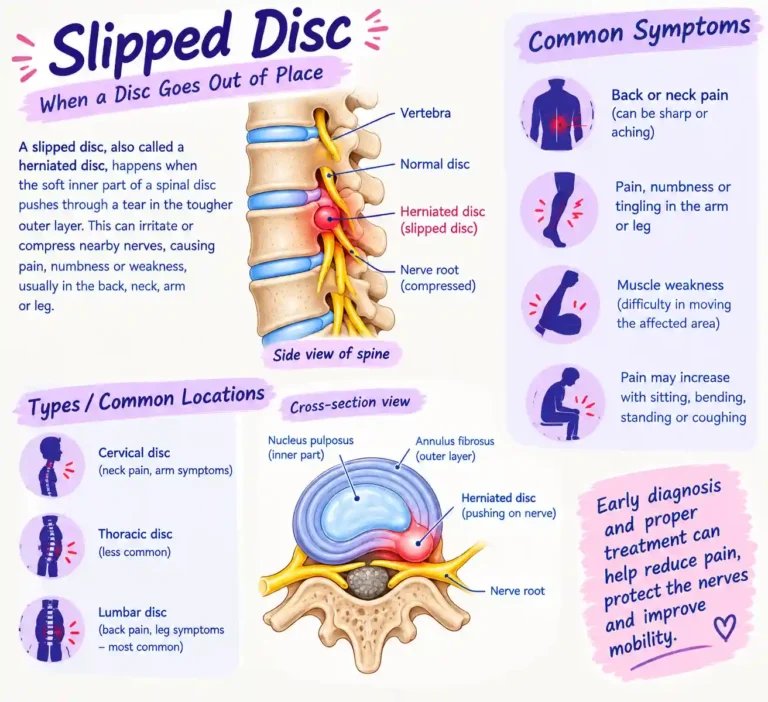
A common feature of the McKenzie Protocol is repeated spinal movements, particularly extension movements, when these movements are appropriate for the individual. Some people with low back pain may experience reduced or centralized pain with specific movements, while others may not respond well to extension and may require a different exercise direction.
McKenzie exercises should be performed gradually and with proper technique. If an exercise causes increasing pain, numbness, weakness, or pain that spreads farther down the leg, it should be stopped and assessed by a qualified physiotherapist or healthcare professional.
One of the best-known McKenzie exercises is the prone press-up, in which the person lies on the stomach and gently lifts the upper body while keeping the pelvis relaxed. Other exercises may include lying prone, standing lumbar extension, and repeated spinal movements. However, the most suitable exercise depends on the individual’s symptoms and movement response.
McKenzie exercises are a movement-based approach commonly used by physiotherapists to help manage low back pain and related stiffness. The approach emphasizes identifying movements or positions that influence a person’s symptoms and then using appropriate repeated movements to improve function.
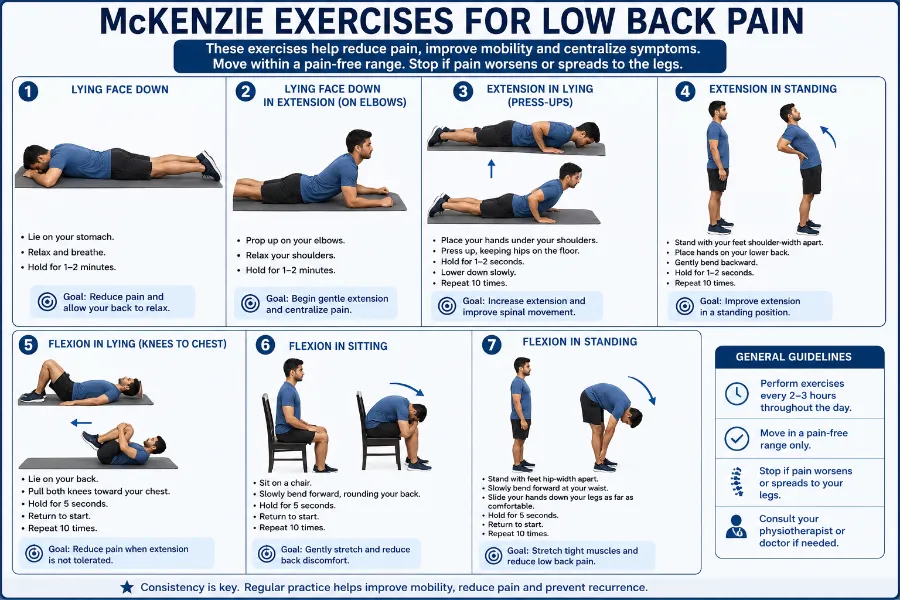
Examples and Guidelines for Seven McKenzie Method Back Pain Exercises
- McKenzie’s back exercises include forward and backward (extension and flexion) bending motions and are done while standing and lying down.
- Pain localization (transfer of pain from the leg closer to the spine) is a positive sign if the leg pain shifts toward the buttocks or lower back and causes a manageable rise in the lower back pain.
- A qualified therapist should supervise the exercises. If these exercises don’t help you, a skilled practitioner might be able to adjust the location and amount of force given to your spine.
Exercises
Lying Face Down
To perform the initial back exercise:
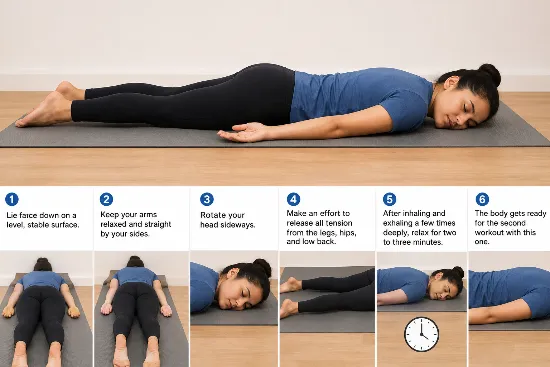
- On a level, stable surface, lie face down.
- Keep your arms relaxed and straight by your sides.
- Rotate your head sideways.
- The exercise won’t be effective if the body isn’t fully relaxed, so make an effort to release all tension from the legs, hips, and low back.
- After inhaling and exhaling a few times deeply, relax for two to three minutes.
- The body gets ready for the second workout with this one.
Lying Face Down In Extension
Perform the second exercise only after finishing the first.
To perform this exercise:
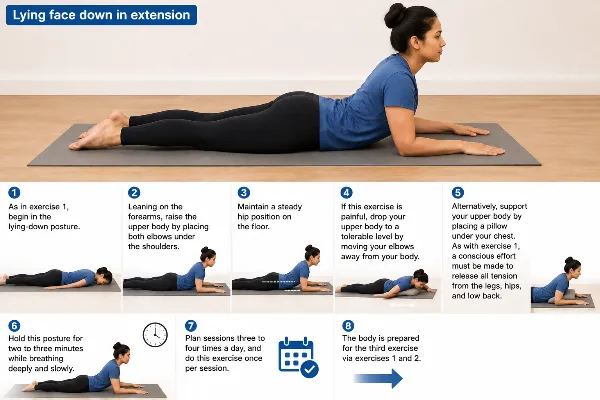
- As in exercise 1, begin in the lying-down posture.
- Leaning on the forearms, raise the upper body by placing both elbows under the shoulders.
Maintain a steady hip position on the floor. - If this exercise is painful, drop your upper body to a tolerable level by moving your elbows away from your body.
- As an alternative, support your upper body by placing a pillow under your chest.
- As with exercise 1, a conscious effort must be made to release all tension from the legs, hips, and low back.
- Hold this posture for two to three minutes while breathing deeply and slowly.
- Plan out the sessions three to four times a day and just do this exercise once per session.
- The body is prepared for the third exercise via exercises 1 and 2.
Extension In Lying
Bending backward is referred to as extension. Only after completing the first and second exercises is the third exercise performed, and it should only be tried if the leg pain has not gotten worse in the previous postures.
To perform this exercise:
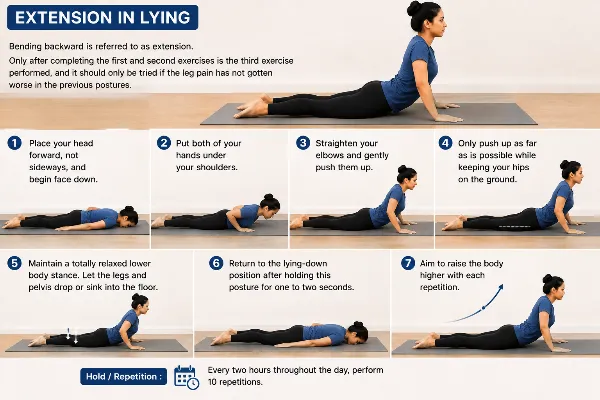
- Place your head forward, not sideways, and begin face down.
- Put both of your hands under your shoulders.
- Straighten your elbows and gently push them up.
- Only push up as far as is possible while keeping your hips on the ground.
- Maintain a totally relaxed lower body stance. Let the legs and pelvis drop or sink into the floor.
- Return to the lying-down position after holding this posture for one to two seconds.
- Every two hours throughout the day, perform ten repetitions of this exercise.
- Aim to raise the body higher with each repetition.
Extension in Standing
Some people may find exercise 3 difficult or painful, or their spine may not be flexible enough to execute the extension action properly. Extension in standing is a great option in these situations.
To perform this exercise:
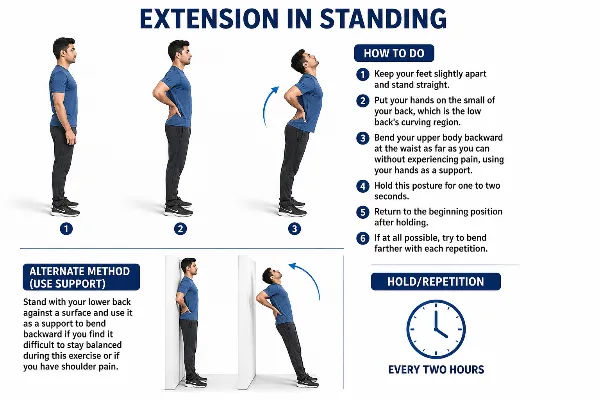
- Keep your feet slightly apart and stand straight.
- Put your hands on the small of your back, which is the low back’s curving region.
- Bend your upper body backward at the waist as far as you can without experiencing pain, using your hands as a support.
- Return to the beginning position after holding this posture for one to two seconds.
- Every two hours during the day, perform ten repetitions of this exercise.
- If at all possible, try to bend farther with each repetition.
- A different method is to stand with your lower back against a surface and use it as a support to bend backward if you find it difficult to stay balanced during this exercise or if you have shoulder pain.
Flexion In Lying
Flexion is the act of bending forward.
To perform this exercise:
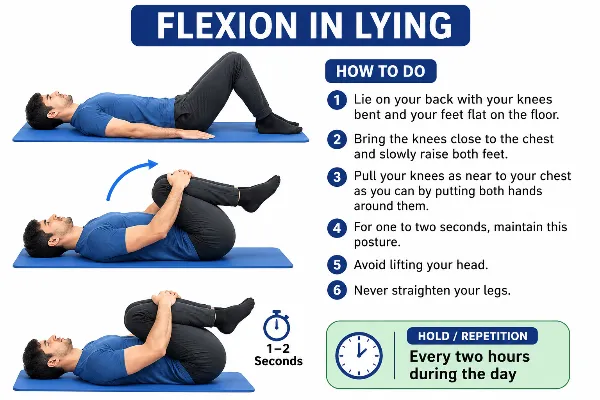
- With your feet flat on the ground and your knees bent, lie on your back.
- Bring your knees close to your chest and slowly raise both feet.
- Pull your knees as close to your chest as you can by putting both hands around them.
- For one to two seconds, maintain this posture.
- Avoid lifting your head.
- Never straighten your legs.
- Every two hours during the day, perform ten repetitions of this exercise.
Flexion In Sitting
Only after performing exercise 5 regularly for at least a week is this exercise advised, and it should only be tried if leg pain has not become worse in the preceding postures.
To perform this exercise:
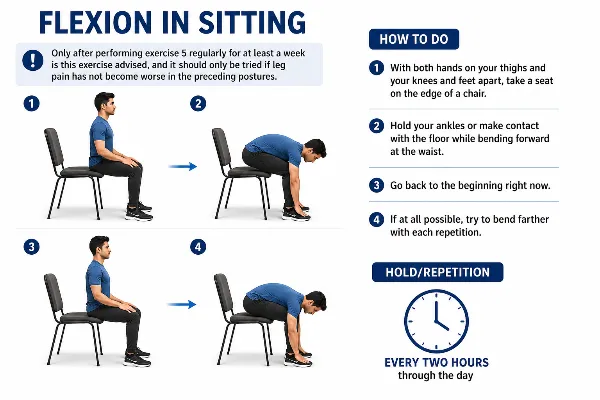
- With both hands on your thighs and your knees and feet apart, take a seat on the edge of a chair.
- Hold your ankles or make contact with the floor while bending forward at the waist.
- Go back to the beginning right now.
- Every two hours throughout the day, perform ten repetitions of this exercise.
- If at all possible, try to bend farther with each repetition.
Flexion In Standing
Only after performing exercise 6 regularly for at least two weeks is this exercise advised.
To perform this exercise:
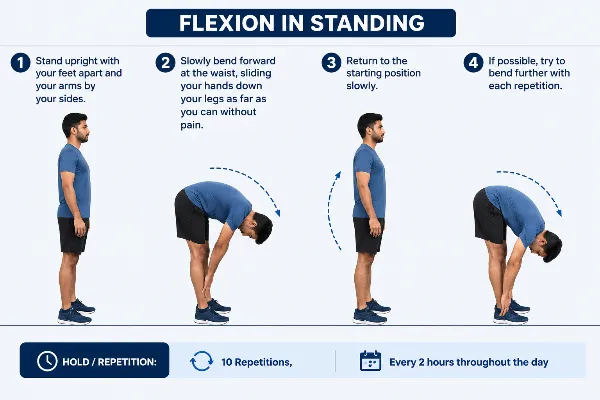
- With your feet apart and your arms by your sides, stand upright.
- Move your hand as far along your leg as you can without experiencing pain while slowly folding down at the waist.
- Go back to the beginning right now.
- Every two hours throughout the day, perform ten repetitions of this exercise.
- If necessary, try to bend further with each repetition.
When Should You Perform The Back Exercises Using The McKenzie Exercises?
Depending on the intensity and length of the pain, the seven back exercises are done in stages. The maximum effect of the workouts is achieved by keeping to the suggested number of repetitions and sessions. Do not perform exercises 1 through 4 while pregnant.
Exercises 1 and 2 should be done while experiencing severe, chronic pain before moving on to exercise 3. Do exercise 4 after exercise 3 if severe pain prevents you from doing it while lying down. Until the intense pain goes away, keep doing exercises 1 through 4 for the first few days.
Exercise 6 may be added to the training session after at least one week of doing exercise 5.1. Exercise may be discontinued and replaced with exercise 6 if it becomes bearable and increases low back flexibility. Exercise 6 can be discontinued and replaced with exercise 7 if it is bearable.
The McKenzie Method for Quickly Relieving Back and Neck Pain: Exercise 3 and a brief rest with the lumbar roll must always come after exercises 5, 6, and 7.
When stiffness or pain is not present:
- To avoid a back pain flare-up or recurrence, do exercise 3 each morning and evening. 1.
- To maintain back conditioning, do exercise 4 before and after hard lifting and at regular intervals while sitting. 1.
- To keep your low back flexible, do exercise 7 once or twice a week.
- The exercises should gradually reduce the intensity of the symptoms or make them bearable throughout each session. Even though there may be occasional episodes of pain, like in exercise 3, symptoms should go away with several sessions.
- A doctor’s appointment is recommended if any activity worsens symptoms that make it difficult to continue the exercise plan.
Contraindications of McKenzie Exercises for Low Back Pain
McKenzie exercises may not be suitable for everyone with low back pain. Avoid starting them without professional guidance if you have:
- Severe or worsening pain: Pain that is intense, rapidly increasing, or not improving with rest.
- Pain radiating into the leg: Especially when accompanied by increasing numbness, tingling, or weakness.
- Cauda equina symptoms: New loss of bladder or bowel control, numbness around the groin or buttocks, or severe weakness in both legs. Seek emergency medical care immediately.
- Recent spinal surgery or serious injury: Such as a fracture, dislocation, or significant trauma.
- Suspected spinal fracture: Particularly after a fall or injury, or in people with known osteoporosis.
- Spinal infection or cancer: Exercise should be guided by the treating medical professional.
- Severe osteoporosis: Avoid forceful spinal movements unless cleared by a healthcare professional.
- Dizziness, faintness, chest pain, or other unusual symptoms during exercise.
Important: McKenzie exercises are movement-based and should be selected according to the individual’s symptoms and response. Stop an exercise if cause an sharp, severe, or progressive worseing pain, and consult a qualified physiotherapist for appropriate modification.
Conclusion
McKenzie exercises can be a useful part of a physiotherapy program for managing certain types of low back pain. By using specific repeated movements and postures, they may help reduce symptoms, improve spinal mobility, and restore confidence in everyday movement. However, the exercises should be selected according to the individual’s symptoms and response to movement rather than performed as a one-size-fits-all routine.
For the best results, McKenzie exercises can be combined with proper posture, regular physical activity, core strengthening, and gradual return to daily activities. If pain becomes severe, spreads farther into the leg, or is accompanied by numbness or weakness, stop the exercise and seek professional assessment.
McKenzie exercises can be a helpful approach for people with certain types of low back pain, particularly when specific spinal movements reduce or centralize their symptoms.
For long-term improvement, McKenzie exercises can be combined with postural education, core and back strengthening, flexibility exercises, regular walking, and healthy movement habits. Consistency is important, but exercises should always be performed within a comfortable and controlled range.
If low back pain is severe or persistent, or if symptoms such as leg weakness, significant numbness, loss of bladder or bowel control, or worsening radiating pain occur, professional medical assessment should be sought promptly. With appropriate exercise selection and guidance from a physiotherapist, many people can gradually improve their movement and return to normal daily activities.
FAQs
Does the McKenzie method work for back pain?
Actually, many patients with sciatica and mechanical lower back pain find success with the McKenzie Method, also known as Mechanical Diagnosis and Therapy (MDT). By centralizing radiating pain and shifting stress away from spinal discs through repetitive movements, such as pushing up while lying on your stomach, it can relieve short-term pain and stiffness.
Who should not do McKenzie exercises?
People with serious spinal conditions, acute fractures, spinal infections, tumors, cauda equina syndrome, severe spinal instability, or advanced spinal stenosis should avoid McKenzie exercises (Mechanical Diagnosis and Therapy), as should anyone whose pain gets worse or spreads further into the limbs when they move.
What are the 5 McKenzie exercises?
In order to relieve pressure and centralize symptoms, the five fundamental McKenzie exercises for lower back pain concentrate on mild spinal extension. They go from flat-lying poses to standing stretches and forceful presses.
Is the McKenzie method good for sciatica?
Yes, the McKenzie Method is frequently quite effective for sciatica, particularly when the nerve pressure is caused by a bulging or ruptured disc. It pushes the disc back by repeating certain movements. This causes pain to return to the spine from the leg. Physicians refer to the process as shift centralization.
How many times a day should I do McKenzie exercises?
During your active hours, you should normally perform McKenzie exercises six to eight times a day, or almost every two hours. Typically, each session requires performing ten movements or repetitions or quickly maintaining a particular position.
Can I do the McKenzie method at home?
Yes, you may apply the McKenzie Method at home, but to make sure the particular exercises are appropriate for your condition, you need to first obtain a proper diagnosis from a qualified physician.
References
- Ocs, N. U. P. D. (2024, February 13). 7 McKenzie Method Exercises for back pain and sciatica. Spine-health. https://www.spine-health.com/wellness/exercise/7-mckenzie-method-exercises-back-pain-and-sciatica
- Sanz, K. (2018, September 26). VIDEO: 7 exercises for back pain using the McKenzie Method [Updated for 2021]. DR-HO’S. https://drhos.com/blogs/learn/video-7-exercises-for-back-pain-using-the-mckenzie-method?srsltid=AfmBOooTzgolGWjTOHrRtP6RV5M0Fz-i5MhSzgvH0pfhEsputJBr4ffZ
- Wong, E. (2024, July 31). 7 McKenzie Method exercises for back pain relief and better range of motion. DR-HO’S. https://drhonow.com/en-int/blogs/learn/7-mckenzie-method-exercises-for-back-pain-relief-and-better-range-of-motion?srsltid=AfmBOoqpojQrtizMeKLsWiLdJIB5GuZnYB_PYVvMYQVUMVL5RmNjsSa