V-Ups Exercise
Introduction
V-Ups are great exercises for strengthening your abdominal muscles. This bodyweight exercise will help you improve your core stability and develop better body control. You will use your abdominal muscles, hip flexors, and stabilising muscles.
V-Ups are often used in ab workouts, athletic conditioning programmes, sport training, and general fitness programmes. V-Ups are much harder compared to traditional crunches,s as you need to move your torso and legs at the same time. This means you need a lot of strength in your abdominal muscles, as well as coordination and flexibility. You can do this exercise without needing any specialized equipment.
This makes it a great exercise to do at home, at the gym, and during your fitness training. Beginners can start with a simple variation such as bent-knee and single-leg V-Ups. If you have stronger abdominal muscles, then you can try doing weighted V-Ups.
If you do this regularly with correct technique, it can help improve strength in your abdominal muscles. Ensuring you keep your spine in a neutral position will help reduce unwanted stress on your lower back.
Below, we will explain everything you need to know about V-Ups, including the benefits, muscles worked, how to do them correctly, variations, mistakes to avoid, precautions, and tips.
What are V-Ups?
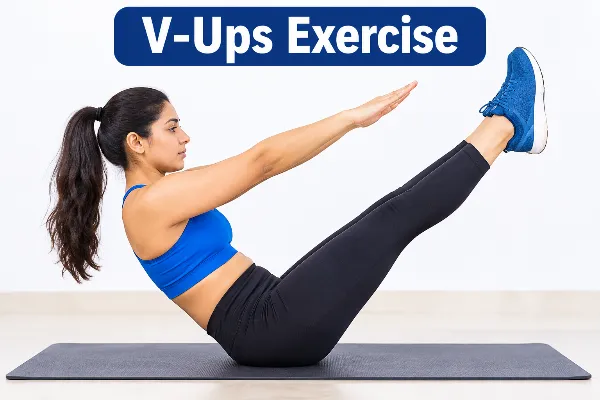
V-Ups are a dynamic ab exercise that involves lifting your upper body and both legs. You will lie on your back and bring your hands and feet together. This will create a V shape in your body.
Your ab muscles will contract to help flex your torso. Your hip flexors will help lift your lower body, and you will use your deeper core muscles to stabilise your pelvis and lower back.
This is a combination of a traditional ab crunch and leg raises.
V-Ups are a great exercise to help improve your core strength and ab endurance. They are also often used in functional fitness programmes due to the need to coordinate between your upper and lower body.
Whilst V-Ups are a simple bodyweight exercise, they do require some strength in your core, flexibility, and coordination. If you suffer from lower back pain or struggle to get into the correct position,n then start with an easier variation.
V-Ups Exercise Video
Muscles Used
V-Ups will target several muscles responsible for moving your abs, hip flexion, and stabilising your torso.
Rectus Abdominis
- This is the main muscle used during V-Ups.
- This muscle runs down the front of your abdomen from your pubic area to your lower ribs and sternum.
- It is responsible for flexing your torso.
- During V-Ups, this muscle will contract as your upper body moves towards your legs.
It will help you control the lowering phase. - Having stronger muscles can help improve strength in your ab muscles. It will also help you have better control in your torso.
Transverse Abdominis
- This is the deepest layer of your ab muscles.
- The muscle runs horizontally around your abdomen.
- This will help stabilise your lower back and pelvis.
- During V-Ups, this muscle will help you brace your ab muscles.
- This ensures you have good control in your torso.
- This muscle is important to ensure you don’t over-arch your lower back.
Internal & External Obliques
- This muscle group runs along the sides of your abdomen.
- They will help you rotate your torso and side bend.
- They also help stabilise your ab muscles.
Iliopsoas
- This is an important hip flexor muscle.
- The iliacus and psoas major are its two major muscles.
- This will help lift your thighs towards your torso.
- During V-Ups, this muscle will help you lift your legs from the floor.
Rectus Femoris
- This muscle is one of the four muscles in your quadriceps.
- It runs along the front of your thigh.
- This muscle separates your hip and knee, in contrast to the other quadriceps muscles.
- This muscle will help flex your hips whilst doing V-Ups.
- This will be more dominant if your legs are kept straight.
Sartorius
- This muscle is a long, thin muscle that runs diagonally along the front of your thigh.
- It will help flex your hips and coordinate your lower body.
- This muscle will help you lift your legs.
Spinal Stabilisers
- These muscles run down your spine and will help you keep control in your torso.
- They will work with your ab muscles to control your spine.
- This will help you keep control.
Benefits Of V-Ups
V-Ups can provide several benefits if done with correct technique
Strengthen Ab Muscles
- V-Ups will help improve strength in your ab muscles.
- As you bring your upper body and legs together, your ab muscles will contract.
- Your rectus abdominis and its attached muscles can get stronger and more resilient with regular exercise.
- Strong ab muscles will help you control your torso movements during activities such as bending, lifting, reaching,g and changing position.
Core Stability
- The capacity to manage your torso while performing different tasks is known as core stability.
- This will challenge your ab muscles to keep your upper and lower body coordinated.
- You will need to have good control in your pelvis and lower back.
- Improving your core control can help improve efficiency during sports, fitness, ss and daily activities.
Strengthen Hip Flexors
- V-Ups will require you to lift your legs towards your torso.
- This will mean your hip flexors will be very active.
- Your iliopsoas and rectus femoris will be involved.
- This can help improve your hip flexor strength to help with activities such as walking, running, climbing stairs, and kicking.
- However, V-Ups shouldn’t be used as a full hip strengthening programme.
Improve Ab Endurance
- Ab endurance is the ability to keep your core muscles contracting.
- Doing multiple reps will challenge your ab muscles.
- You may increase your muscle endurance by gradually increasing the number of repetitions.
Improve Body Coordination
- V-Ups will require you to lift your upper and lower bodies.
- Your arms, torso, and legs will need to work together to get into the correct position.
- Your awareness and control of your body may increase as a result.
- It can also help during general fitness activities where you need to coordinate your upper and lower body.
Help With Athletic Conditioning
- A strong and coordinated core is important for many athletic movements.
- Athletes who play sports such as running, gymnastics, martial arts, swimming, and field sports will need to have good control in their torso. V-Ups can be used as part of your athletic conditioning programme.
- However, sport-specific training should also include exercises to improve your strength, balance, power and control.
No Specialist Equipment Required
- You can perform this exercise without any additional equipment, relying solely on your own body weight. Whilst having a comfortable mat to exercise on will help, you don’t need any extra equipment.
- This makes it a great exercise to do at home, outside, and at the gym for ab training.
Can Be Done For All Fitness Levels
- There are several variations of V-Ups, ps so you can alter the difficulty depending on your fitness level.
- Beginners can do bent-knee and single-leg V-Ups.
- Those with stronger cores can do straight-leg, weighted, and rotational V-Ups.
Dynamic Core Control
- Unlike static exercises,s this will challenge your core to move your torso.
- Your ab muscles will need to control your torso during the full movement.
Help With A Balanced Programme
- This can be combined with other ab and core exercises.
- Such as planks, dead bugs, bird dogs and reverse crunches.
- By varying the pattern of your exercises, you will create a well-balanced core programme.
- Note that while this will help strengthen your ab muscles, it won’t help you lose belly fat.
To lose fat from your abdomen, you will need to follow a balanced approach involving good nutrition, regular physical activity, sleeping,g and living a sustainable lifestyle.
How To Do V-Ups
Correctly doing V-Ups will help you engage your ab muscles and reduce unwanted stress on your lower back.

Starting Position
- Lie on your back on a comfortable mat.
- Keep your legs straight and together.
- Extend your arms above your head.
- Ensure your shoulders are relaxed and your neck is in a neutral position.
- Gently engage your ab muscles.
- Keep your spine in a comfortable position.
Technique
- Engage your ab muscles.
- Move your arms forward.
- Continue to lift until your hands and feet are close together.
- At this point, your body should resemble a V.
- Ensure you keep your movements controlled.
- Slowly lower your upper body and legs.
- Return to the lying position.
- Repeat.
Breathing
- As you raise your legs and upper torso, release the breath.
- Inhale slowly as you lower your body.
- Don’t hold your breath.
- Number Of Repetitions
- Beginners can start with:
- 5-8 reps per set
- 1-2 sets
- Rest for around 45-60 seconds between sets.
- Those with stronger ab muscles can gradually increase to:
- 10-15 reps per set.
- 2-3 sets.
- Rest for however long your fitness level allows.
- Quality of reps is most important.
Variations
There are several ways to alter V-Ups to make it harder or easier.
Depending on your ab strength, flexibility,c coordination, and experience.
Bent Knee V-Ups
- Bent V-Ups are a great option for beginners.
- This will reduce the length of your legs and make it easier to control.
How To Do
- Lie face-up with your knees flexed and both feet resting firmly on the floor.
- Extend your arms above your head.
- Engage your ab muscles.
- Lift your upper body and bring your knees (bent) towards your chest.
- Reach your arms towards your knees/ shins.
- Slowly return to the starting position.
- Repeat.
Benefits
- Helps build strength in your ab muscles.
- Easier than straight-leg V-Ups.
- Helps improve coordination between your torso and lower body.
- A great beginner variation.
Single Leg V-Ups
Single-leg V-Ups involve lifting your leg and upper body at the same time.
Your other leg will be extended.
How To Do
- Lie on your back with your legs extended.
- Keep your arms above your head.
- Lift one leg towards the ceiling and your upper body.
- Reach your arms towards your raised leg.
- Slowly lower your upper body and leg.
- Repeat on the other leg.
Benefits
- Builds unilateral ab control.
- Allows you to practice V-Ups with less difficulty.
- Challenges coordination and torso stability.
- Helps identify any difference in control between both sides.
Alternating V-Ups
Alternating V-Ups involve lifting one leg at a time.
How To Do
- Lie on your back with your legs straight.
- Place your arms above your head.
- Lift your upper body and right leg.
- Reach your arms towards your right foot.
- Carefully lower your body.
- Repeat on your left leg.
- Alternate.
Weighted V-Ups
Weighted V-Ups are a more advanced variation.
You can use a light dumbbell or medicine ball to increase the difficulty.
How To Do
- Lie on your back with your legs extended.
- Hold onto a light dumbbell or medicine ball with both hands.
- Extend your arms above your head.
- Engage your ab muscles.
- Lift your legs and upper body.
- Bring the weight towards your feet.
- Slowly lower your body.
Benefits
- Increases resistance during ab training.
- Challenges muscle strength and endurance.
- Improves control when flexing your torso.
- Start with a light weight and ensure you are using correct technique.
Don’t add any weights if you can’t do regular V-Ups comfortably.
Cross Body V-Ups
Cross-body V-Ups involve rotating your torso.
How To Do
- Lie on your back with your legs extended.
- Extend your arms above your head.
- Lift your upper body and right leg.
- Rotate your torso slightly and bring your left hand towards your right foot.
- Slowly return to the starting position.
- Repeat on the other side.
Benefits
- Challenges your abdominal obliques.
- Improves torso control with rotation.
- Builds coordination between opposing limbs.
- Ensure you are rotating within a controlled range.
- Don’t force your lower back.
Tuck V-Ups
Tuck V-Ups involve tucking your knees towards your chest.
How To Do
- Lie on your back with your legs extended.
- Keep your arms above your head.
- Lift your shoulders and tuck both knees towards your chest.
- Bring your arms forward towards your knees.
- Hold for a second.
- Slowly extend your legs and lower your upper body.
Benefits
- A variation of V-Ups.
- Challenges abdominal contraction.
- Helps build coordination and core endurance.
Jackknife V-Ups
Jackknife V-Ups involve bringing your arms and legs together.
How To Do
- Stretch your arms over your head while lying on your back.
- Keep your legs straight
- Lift both legs and your upper body.
- Reach your hands towards your toes.
- Ensure you are in a controlled V shape.
- Slowly lower your body.
Benefits
- Builds ab strength.
- Challenges dynamic torso control.
- Improves coordination between upper and lower body.
- This is very similar to standard V-Ups.
Medicine Ball V-Ups
This variation uses a medicine ball to increase resistance and challenge your coordination.
How To Do
- As you raise your legs and upper torso, release the breath.
- Extend your arms above your head.
- Keep your legs straight.
- Lift your upper body and legs.
- Bring the medicine ball towards your feet.
- Slowly lower your body.
- Repeat.
Benefits
- Increases resistance during ab training
- Challenges coordination between upper body and core.
- Builds muscle endurance.
Pike V-Ups
- Pike V-Ups focus on keeping your legs straight.
- This will require good flexibility and control in your ab muscles.
How To Do
- Lie on your back with your legs straight.
- Extend your arms above your head.
- Lift both legs and your upper body.
- Keep your knees as straight as possible.
- Reach towards your toes.
- Slowly return to the starting position.
Benefits
- Challenges your ab muscles.
- Requires more hamstring flexibility.
- Builds coordination and body control.
Common Mistakes
V-Ups are a great way to strengthen your ab muscles. However, if done incorrectly, they can reduce effectiveness and cause unwanted strain.
Avoid the following mistakes.
Swinging
- Swinging your arms and legs will reduce the amount of controlled muscle effort.
- It can also make it difficult to keep your spine in the correct position.
- Do this slowly and focus on engaging your ab muscles.
Jerking Head Forward
- Some people will jerk their head forward to reach their feet.
- This can cause unwanted tension in your neck.
- Keep your neck relaxed and don’t jerk your head forward.
- Let your torso lift with your ab muscles.
Bending Knees
- During standard straight-leg V-Ups, you may bend your knees too much.
- Try to keep your legs straight if you have enough strength and flexibility.
- If straight-leg V-Ups are too difficult, then intentionally do bent-knee variations.
Letting Legs Drop Too Fast
- Letting your legs drop quickly will reduce control.
- Lower both legs slowly.
Overarching Lower Back
- Some people will over-arch their lower back when lowering their legs.
- This can cause unwanted discomfort for those who are sensitive to extending their lower back or struggle to control their pelvis.
- Reduce the range of movement and ensure you are keeping good tension in your ab muscles.
- Stop lowering your legs when you feel your lower back losing control.
Too Many Reps
- Trying to do too many reps without enough strength can cause poor technique.
- Gradually increase the number of repetitions from a manageable starting point.
Holding Breath
- Holding your breath can cause issues with your breathing.
- Exhale when lifting and inhale when lowering.
Conclusion
V-Ups are an effective abdominal strengthening exercise that helps improve core stability, abdominal muscle strength, balance, and overall body coordination. This exercise targets the upper and lower abdominal muscles while also engaging the hip flexors and other supporting core muscles. When performed with proper technique and controlled movements, V-Ups can help develop stronger abdominal muscles, improve core endurance, and support better performance in daily activities and fitness routines.
For the best results, start with a manageable number of repetitions and gradually increase the intensity as your strength improves. Avoid rushing through the movement, swinging your arms or legs, or straining your neck and lower back. Beginners can start with modified V-Ups and progress to the full variation over time. Consistency, proper form, and adequate recovery are essential for achieving better core strength and fitness.
FAQs
What are V-Ups exercises?
V-Ups are an abdominal strengthening exercise that involves lifting your upper body and legs simultaneously to form a V shape. These exercises build abdominal strength while enhancing stability and control throughout the core region.
Which muscles do V-Ups work?
V-Ups primarily target the rectus abdominis (six-pack muscles). They also engage the transverse abdominis, obliques, hip flexors, and other supporting core muscles.
Are V-Ups good for building abs?
Yes, V-Ups are an effective bodyweight exercise for strengthening the abdominal muscles, improving core endurance, and developing better abdominal control.
Can V-Ups help reduce belly fat?
V-Ups strengthen abdominal muscles but cannot directly burn fat from a specific area. Combining regular exercise, cardiovascular activity, and a balanced diet can help reduce overall body fat.
Are V-Ups suitable for beginners?
Yes, beginners can perform modified V-Ups by bending their knees or lifting one leg at a time. These variations help develop core strength before progressing to full V-Ups.
How often should I perform V-Ups?
You can include V-Ups in your abdominal workout 2–3 times per week, allowing sufficient recovery between intense core-training sessions.
Are V-Ups better than crunches?
V-Ups involve simultaneous upper-body and leg lifting, requiring greater core coordination and strength. Crunches are generally easier for beginners. Both exercises can be useful in an abdominal strengthening routine.
References
- How to do V-Ups | Exercise Library | ACE. (n.d.). https://www.acefitness.org/resources/everyone/exercise-library/242/v-ups/?utm_source
- Army Physical Readiness Training (TC 3-22.20). (2010). [Draft]. Headquarters, Department of the Army. https://cpb-us-w2.wpmucdn.com/sites.widener.edu/dist/c/12/files/2019/01/TC_3-22.20_PRT-1sgjgrt.pdf?utm_source
- Core Exercises: Guidelines and examples. (n.d.). HealthyChildren.org. https://www.healthychildren.org/english/health-issues/injuries-emergencies/sports-injuries/pages/core-exercises-guidelines-and-examples.aspx?utm_source