Bee Breath (Bhramari Pranayama)
Introduction
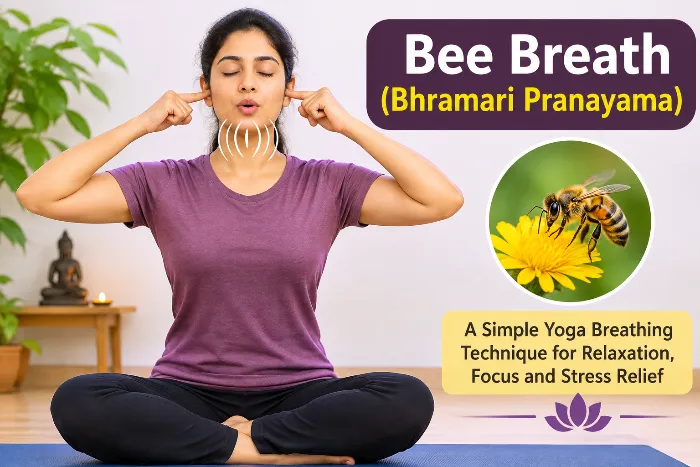
Bee Breath, traditionally known as Bhramari Pranayama, is a calming breathing technique rooted in ancient yoga practice. The word Bhramari comes from the Sanskrit word Bhramar, meaning a bee. This breathing exercise gets its name from the gentle humming sound produced during exhalation, which resembles a bee’s buzz.
Bhramari Pranayama is a simple yet effective breathing practice that involves inhaling slowly through the nose and producing a soft, continuous humming sound while breathing out. During the practice, the lips remain gently closed, the jaw stays relaxed, and the attention is directed towards the vibration created by the humming sound.
This technique is commonly included in yoga, meditation, relaxation, and stress-management routines. It encourages slow, controlled breathing and helps practitioners develop greater awareness of their breathing patterns. The humming sound also provides a focal point for attention, making it easier to settle the mind and reduce distractions during meditation.
In today’s busy lifestyle, many people experience stress, mental fatigue, poor sleep habits, and difficulty maintaining concentration. Spending a few minutes practising a gentle breathing technique such as Bhramari Pranayama may help support relaxation and emotional well-being.
Although traditional yoga describes several benefits of Bhramari Pranayama, modern scientific research on this specific technique is still developing. Some studies suggest potential benefits for relaxation, autonomic nervous system activity, and stress management. However, it should be considered a complementary wellness practice rather than a replacement for medical treatment.
How does bee breath work?
Bhramari Pranayama combines three important elements: controlled breathing, vocal humming, and focused attention.
These elements may work together to encourage a relaxed state.
Slow and controlled breathing
During Bhramari, the practitioner inhales gently and exhales slowly. This encourages awareness of the respiratory cycle and may help reduce rapid, shallow breathing associated with stressful situations.
Humming vibration
The humming sound creates vibrations around the mouth, nose, and facial region. These sensations provide additional sensory feedback and may help practitioners maintain attention during exhalation.
Attention and concentration
Focusing on the humming sound can reduce attention to distracting thoughts and environmental noise. This makes the technique useful as a preparation for meditation.
Relaxation response
Slow, comfortable breathing may influence the autonomic nervous system, which regulates functions such as heart rate and breathing. Research on slow breathing suggests that breathing patterns can affect cardiovascular and autonomic regulation.
However, the precise physiological mechanisms and long-term effects of Bhramari itself require further research.
Muscles and Body Parts Involved in Bee Breath
Bhramari Pranayama is not a conventional strengthening exercise.
It is primarily a breathing and relaxation technique.
However, several muscles and body structures participate in breathing and humming.
Diaphragm
- The diaphragm is the primary muscle responsible for breathing.
- During inhalation, it contracts and moves downward, allowing the lungs to expand.
During exhalation, it relaxes and moves upward. - In Bee Breath, gentle inhalation and controlled exhalation involve the natural movement of the diaphragm.
Intercostal Muscles
- Intercostal muscles are located between the ribs.
- They assist with the expansion and movement of the rib cage during breathing.
- Relaxed breathing allows the rib cage to move comfortably without unnecessary tension.
Vocal Cords
- The larynx, often known as the voice box, contains the vocal cords.
- When producing the humming sound, the vocal folds vibrate as air passes through them.
- This creates the characteristic buzzing sound of Bhramari.
Facial Muscles
- The facial muscles help maintain a relaxed facial position during the exercise.
- The lips remain gently closed while the jaw and forehead should remain relaxed.
Neck and Shoulder Muscles
- The neck and shoulder muscles help maintain an upright sitting posture.
- However, they should not be unnecessarily tightened during breathing.
- Keeping the shoulders relaxed helps prevent tension during the practice.
How to Perform Bee Breath (Bhramari Pranayama)
Correct technique is important to get the most from Bhramari Pranayama.
The exercise should be performed slowly, comfortably, and without forcing the breath.
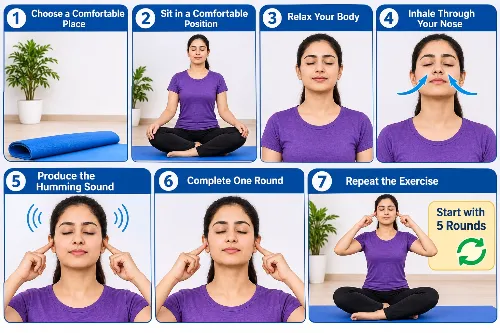
Follow these steps.
Step 1: Choose a Comfortable Place
- Find a quiet and comfortable place where you can practise without interruptions.
- Use a yoga mat or comfortable floor surface.
- Ensure that the room has sufficient ventilation.
- Avoid practising immediately after a heavy meal.
- Keep your phone and other distractions away.
Step 2: Sit in a Comfortable Position
- Sit cross-legged on a yoga mat.
- Alternatively, sit on a chair with your feet resting comfortably on the floor.
- Keep your spine naturally upright.
- Relax your shoulders.
- Lightly place your hands on your thighs or knees.
- Avoid excessive arching of your lower back.
- You can use a cushion under your hips if sitting on the floor feels uncomfortable.
Step 3: Relax Your Body
- Close your eyes gently if comfortable.
- Relax your forehead and facial muscles.
- Keep your jaw relaxed.
- Let your shoulders drop down from your ears.
- Take a few natural breaths.
- Bring your attention towards your breathing.
- Avoid holding your breath or attempting to breathe deeper than is comfortable.
Step 4: Inhale Through Your Nose
- Slowly inhale through both nostrils.
- Let your rib cage and abdomen grow organically.
- Keep your neck and shoulders relaxed.
- Avoid taking a forced or excessively deep breath.
Step 5: Produce the Humming Sound
- Keep your lips gently closed.
- Relax your jaw and tongue.
- Slowly exhale through your nose.
- Produce a smooth humming sound similar to the buzzing of a bee.
- Keep the sound steady and comfortable.
- Feel the soft vibration in your face, lips, and nose.
- The humming sound should continue throughout the comfortable exhalation.
Step 6: Complete One Round
- Finish the exhalation naturally.
- Allow yourself to take another comfortable inhalation.
- Repeat the same humming technique.
- Avoid rushing between rounds.
- One inhalation followed by one humming exhalation is considered one round.
Step 7: Repeat the Exercise
- Beginners can start with five rounds.
- Maintain a comfortable breathing rhythm.
- Keep your face, jaw, and shoulders relaxed.
- Stop if you feel dizzy, breathless, or uncomfortable.
Benefits
There is more to humming bee breath than just a brief moment of peace. When done regularly, this exercise, which integrates breath, sound, and vibration, may provide mild therapeutic effects, relieve mental and emotional stress, and support the body physiologically.
Physical Benefits
- Bhramari’s use of humming vibration could accomplish more than just produce a calming sound.
- Additionally, it can affect physical relaxation and breathing patterns in ways that make the practice seem particularly healing.
- Increases nose nitrate output: Research has demonstrated that humming, as opposed to silent exhalation, increases nasal nitric oxide output.
This might occur because the vibration enhances the movement of air between the nasal passages and sinuses. - May aid in maintaining appropriate heart rate and blood pressure regulation: According to preliminary studies, Bhramari may have a beneficial impact on relaxation responses and heart rate variability. Those who are struggling with tension brought on by stress may find this particularly beneficial.
- May aid in voice and throat relaxation: The humming exhale’s mild vibration can be calming to the face and throat. For some, it encourages relaxation and relieves tension.
Mental And Emotional Benefits
The relaxing impact of humming bee breath is one of the main reasons people use it. Internal noise can be reduced, and a stronger sensation of calmness can be produced by the gradual exhale and soft sound.
- The most well-known benefit of bhramari is its ability to calm the nervous system: The body and mind may become calmer as a result of the extended exhale, internal sound, and mild vibration.
- Reduces agitation, aggression, and mental restlessness: When the mind feels reactive, overstimulated, or uneasy, the humming exhale can be particularly beneficial since it naturally slows you down.
- Promotes mindfulness and interior focus: Humming Bee Breath promotes quiet and inner awareness, in contrast to quick or stimulating pranayama techniques. This makes it a beneficial exercise to do after the conclusion of yoga or before meditation.
Therapeutic Benefits
- Humming Bee Breath may have positive effects on general well-being even if it is not a medical therapy.
- Regular practice can make it a basic tool for rest, relaxation, and nervous system control.
- Humming Bee Breath is quiet, easy, and incredibly relaxing, which may enhance the quality of your sleep.
- It may help calm racing thoughts and get the body ready for sleep if you practice it before bed.
- Bhramari may aid in promoting relaxation and supporting autonomic balance, according to studies and reviews.
- To put it simply, it could assist the body in moving away from a condition of high stress.
When to Practice Bee Breath Humming
Humming Bee Breath is best done in the morning on an empty stomach, when the mind is less occupied, and the breath feels clear. Nevertheless, it may also be quite successful:
- Before going to bed to relax
- Midday when stress levels are high
- After doing yoga to calm the body
- To prepare the mind before meditation
- Five to ten minutes a day is sufficient for the majority of people.
- It’s reasonable to anticipate that you could feel calmer right away after a session, but regular practice over a period of two to four weeks usually yields more visible overall effects.
Start modestly and concentrate more on consistency than intensity if you’re new to pranayama.
Different Types of Bee Breath (Bhramari Pranayama)
There are different ways to practise Bhramari. Beginners should start with the simple version before trying variations.
Basic Bhramari
This is the simplest form of Bee Breath.
How to perform:
- Sit comfortably on a yoga mat or chair.
- Keep your spine upright.
- Close your eyes gently.
- Inhale through your nose.
- Slowly exhale while producing a humming sound.
- Complete five comfortable rounds.
This version is suitable for beginners who want to learn the basic breathing pattern.
Bhramari with Shanmukhi Mudra
Shanmukhi Mudra is a traditional hand position sometimes incorporated into Bhramari Pranayama. The name refers to closing or withdrawing attention from the sensory openings.
How to perform:
- Sit comfortably with your spine.
- Close your eyes gently.
- Place your thumbs gently over the outer ears without pressing deeply into the ear canals.
- Place your index fingers lightly near the eyelids.
- Rest your middle fingers alongside the nose without blocking the nostrils.
- Place your ring and little fingers gently around the area of the upper and lower lips.
- Inhale comfortably through the nose.
- Exhale slowly while producing a steady humming sound.
- Repeat for up to five comfortable rounds.
- Important: Do not press on your eyeballs or block your nasal passages.
Beginners can simply practise Bhramari without this hand position.
Gentle Humming Bee Breath
This variation uses a softer and quieter humming sound.
How to perform:
- Sit comfortably.
- Keep your eyes closed or look gently downward.
- Inhale naturally through your nose.
- Keep the sound gentle and relaxed.
- Repeat for three to five rounds.
- This variation may be useful for people who prefer a quieter breathing practice.
Bhramari Before Meditation
Bee Breath can also be practised before a meditation session.
How to perform:
- Sit in a comfortable meditation position.
- Relax your shoulders and facial muscles.
- Perform five rounds of Bhramari.
- After the final round, return to normal breathing.
- Sit quietly for two to five minutes.
- Observe your natural breathing without trying to change it.
This approach helps create a transition from an active daily routine to a quieter meditation practice.
Common Mistakes to Avoid During Bhramari Pranayama
Although Bee Breath is a simple breathing exercise, incorrect technique can reduce comfort and make the practice less effective.
Avoid the following mistakes.
Producing a Very Loud Humming Sound
- The humming sound should be gentle and continuous.
- Producing a very loud sound can create unnecessary tension in the throat and facial muscles.
- Correction: Maintain a soft, comfortable buzzing sound.
Forcing the Exhalation
- Some beginners try to extend the humming sound for as long as possible.
- This may lead to breathlessness or discomfort.
- Correction: Allow the breath to leave naturally without forcing the exhalation.
Holding the Breath Unnecessarily
- Breath-holding is not required for basic Bhramari Pranayama.
- Correction: Maintain a smooth breathing pattern without unnecessary pauses or breath retention.
Keeping the Shoulders Tight
- Raising the shoulders during inhalation can create unnecessary muscle tension.
- Correction: Keep your shoulders relaxed and allow natural rib cage and abdominal movement.
Pressing Too Hard on the Ears
- In the Shanmukhi Mudra variation, some practitioners apply excessive pressure around their ears.
- Correction: Use gentle finger placement and avoid inserting your fingers into the ear canals.
Practising Too Many Rounds Initially
- Beginners sometimes try to perform too many rounds during their first session.
- Correction: Start with three to five rounds and increase gradually according to comfort.
Sitting with Incorrect Posture
- A rounded back or excessively stiff sitting position can make comfortable breathing difficult.
- Correction: Maintain a naturally upright spine and use a chair or cushion if necessary.
Tightening the Jaw and Face
- Unnecessary facial tension can make humming uncomfortable.
- Correction: Keep your jaw relaxed, lips gently closed, and forehead soft.
Precautions and Contraindications of Bee Breath
Bhramari Pranayama is generally a gentle breathing technique, but certain precautions are important.
Before starting any new breathing exercise, individuals with existing medical conditions should consider professional guidance.
Ear Infection
- People experiencing an active ear infection, ear pain, or significant ear discomfort should avoid practising Bhramari until they have received appropriate medical advice.
- The humming sound and ear-covering variation may be uncomfortable.
Nasal Infection or Severe Congestion
- People with severe nasal congestion, acute nasal infection, or difficulty breathing through the nose may find this exercise uncomfortable.
- Avoid forcing nasal inhalation.
Dizziness or Lightheadedness
- Stop the exercise if you experience dizziness, lightheadedness, or unusual discomfort.
- Return to normal breathing and sit comfortably until the symptoms settle.
High Blood Pressure
- People with high blood pressure should avoid straining or holding their breath.
- The basic Bhramari technique does not require breath retention.
- Individuals with uncontrolled hypertension should consult their healthcare professional before starting a new pranayama routine.
Heart Conditions
- People with heart disease should practise only gentle breathing without breath-holding and should follow advice from their treating healthcare professional.
Recent Ear or Eye Surgery
- People recovering from ear or eye surgery should seek medical clearance before practising, especially before using Shanmukhi Mudra.
Respiratory Conditions
- People with asthma, COPD, or other respiratory conditions should not use Bhramari as a replacement for prescribed inhalers, medications, or respiratory rehabilitation.
- If the exercise causes coughing, wheezing, or breathlessness, stop practising.
Pregnancy
- Pregnant individuals who wish to practise Bhramari should use a comfortable sitting position and avoid breath retention or straining.
- Those with pregnancy-related complications should seek guidance from their healthcare provider.
- Important: Never force the breathing pattern.
Stop immediately if you experience chest pain, severe dizziness, unusual shortness of breath, or significant discomfort.
Conclusion
Bee Breath (Bhramari Pranayama) is a simple and effective yogic breathing technique that involves producing a gentle humming sound during exhalation. It is an excellent addition to a daily yoga, meditation, and relaxation routine. Regular practice may help reduce stress, promote mental relaxation, improve concentration, encourage mindfulness, and develop better breathing awareness.
To perform this exercise, sit comfortably with your spine upright, inhale gently through your nose, and slowly exhale while producing a soft humming sound like a bee. Beginners can start with three to five rounds and gradually increase the practice according to their comfort.
Bhramari Pranayama does not require any special equipment and can be practised at home, in the workplace, or before bedtime. However, avoid forcing your breath, straining your throat, or holding your breath unnecessarily.
FAQs
What is Bee Breath (Bhramari Pranayama)?
Bee Breath, also called Bhramari Pranayama, is a yogic breathing exercise in which a person inhales through the nose and produces a gentle humming sound while exhaling. The sound resembles a bee’s buzz.
What are the main benefits of Bhramari Pranayama?
The main potential benefits include relaxation, improved breathing awareness, better concentration, reduced feelings of stress, and support for meditation. Some research has also investigated its effects on sleep and cardiovascular function.
How many times should I practise Bhramari Pranayama?
Beginners can start with three to five rounds. More experienced practitioners may gradually increase to eight or ten rounds if comfortable.
What is the best time to practise Bee Breath?
Bee Breath can be practised in the morning, evening, or before bedtime. Many people also include it before meditation or after a stressful activity.
Can beginners practise Bhramari Pranayama?
Yes. Beginners can practise the basic technique without using Shanmukhi Mudra. Start with a comfortable sitting position, gentle nasal inhalation, and soft humming during exhalation.
Can Bhramari Pranayama help with anxiety?
Bhramari may help promote relaxation and reduce feelings of everyday stress and anxiety. However, it is not a substitute for professional treatment for an anxiety disorder.
Can I practise Bee Breath before sleeping?
Yes. Some individuals include a few gentle rounds in their bedtime relaxation routine. Avoid forcing your breath or producing a loud humming sound.
References
- Pubmed.ncbi.nlm.nih.gov. (n.d.-b). https://pubmed.ncbi.nlm.nih.gov/29321984/
- Chetry, D., Chhetri, A., Rajak, D. K., Rathore, V., & Gupta, A. (2024). Exploring the health benefits of bhramari pranayama(humming bee breathing): A comprehensive literature review. Indian Journal of Physiology and Pharmacology, 68, 71–85. https://doi.org/10.25259/ijpp_325_2023
- Kuppusamy, M., Kamaldeen, D., Pitani, R., Amaldas, J., & Shanmugam, P. (2018). Effects of Bhramari Pranayama on health: A systematic review. Journal of Traditional and Complementary Medicine, 8(1), 11–16.