Clasp Hand Behind Back Stretch
Introduction
The Clasp Hands Behind Back stretch is a simple and effective upper body stretch that can help improve shoulder mobility, flexibility, and posture. The exercise involves placing your hands behind your back and trying to clasp your fingers together. This helps to encourage mobility in the chest, shoulder,r and upper arm muscles.
Many people will suffer from tightness in their shoulders and chest due to prolonged sitting, working at a desk, using their mobile phone, poor posture, and lack of regular exercise. As a result, shoulder mobility may be reduced, and the shoulders may curve forward. This can then make it difficult to reach behind your back and put on your clothes.
This exercise is great to improve shoulder flexibility and can be used as a daily stretch, warm-up, posture correction, and mobility exercise.
No equipment is required to perform this exercise,e making it great for beginners, office workers, athletes, es and anyone wanting to improve mobility in their shoulders.
In this article, we will look at how to perform the Clasp Hand Behind Back stretch, the benefits, muscles targeted, common mistakes, variations, precautions, and top tips.
What is the Clasp Hand Behind Back Stretch?
The Clasp Hand Behind Back stretch is a mobility exercise targeting the shoulders, chest, and upper arms.
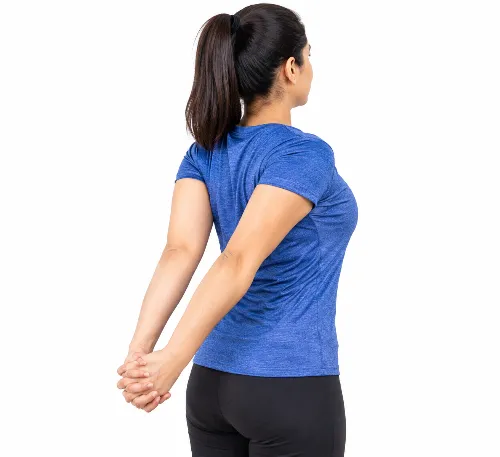
During the exercise, you place both your arms behind your body and try to clasp your hands/fingers together.
This creates a nice stretch across the front of your shoulders and chest as you gently pull your shoulders backwards and open your chest.
This can also improve internal and external rotation of the shoulders, depending on the arm positioning and flexibility.
This exercise is commonly used:
During shoulder mobility exercises
- Upper body mobility
- Correcting rounded shoulders
- Opening up the chest
- Improving Posture
- General fitness and rehab
No specialist equipment is required; however, if you are a beginner and struggling to reach your hands together, you can use a yoga strap or towel.
How to perform the Clasp Hands Behind Back stretch?
This exercise should be performed correctly to avoid any strain on your shoulders and maintain good posture.
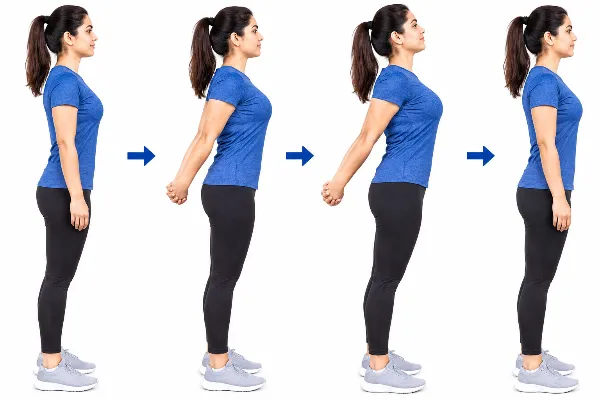
Start Position
- Place your feet shoulder-width apart, standing tall.
- Maintain a neutral spine and slightly bent knees.
- Allow your arms to hang by your sides.
- Relax your shoulders and keep your head neutral.
- Move your arms behind your back slowly.
- You can slightly bend your elbows.
- Keep your chest relaxed and shoulders away from your ears.
- Clasp your hands.
- Bring your hands together behind your lower back.
- Try to clasp your fingers together comfortably.
- If your fingers aren’t long enough, you can use a towel or stretching strap.
Straighten your arms.
- Gently straighten your elbows as much as possible.
- Don’t force your arms into a straight position.
- Keep your wrists relaxed.
Open your chest.
- Gently pull your shoulders back.
- Don’t overarch your lower back, but raise your chest a little.
- Keep your neck relaxed and chin neutral.
- Hold in this position for 15-30 seconds.
- Inhale and exhale slowly.
- Feel the front of your shoulders and your chest gently stretched.
Release.
- Slowly relax your shoulders.
- Release your fingers and bring your arms back to your sides.
- Repeat 2-3 times.
- Hold for 15-30 seconds.
Muscles Targeted
This exercise primarily targets the muscles in your shoulders, chest,t and upper arms.
Many supporting muscles also help maintain good posture.
- This large muscle runs across your chest.
- As your arms are moved behind your body, you will feel a nice stretch in your chest.
- This can help alleviate tightness in your chest and help improve comfortable shoulder mobility.
Pectoralis Minor:
This is a smaller muscle found underneath the pectoralis major.
- This connects the upper ribs to the coracoid process of your scapula.
- Your shoulders may curve forward and become less mobile if this muscle is tense.
- Depending on your shoulder positioning, this exercise can give you a gentle stretch in this area.
Anterior Deltoid:
- The front of your shoulder includes this muscle.
- It helps with shoulder flexion and internal rotation.
- As your arms are moved behind your body, this muscle will be stretched.
Biceps Brachii:
- The front of your upper arm contains this muscle.
- Depending on your elbow and shoulder positioning, this can create a slight stretch in the long head of your biceps.
Triceps Brachii:
- The back of your upper arm contains this muscle.
- It helps with elbow extension and upper arm movement.
- How much this muscle is stretched depends on your arm and elbow positioning.
Rhomboids:
- These muscles are found between your scapula and spine.
- They help with retraction of your scapula and maintaining good posture.
- Whilst this exercise isn’t specifically targeting your rhomboids, they will help to stabilise your scapula.
Benefits of the Clasp Hands Behind Back stretch
If performed regularly with correct form, rm this exercise can offer many benefits.
Improves Shoulder Flexibility:
- One of the main benefits of this exercise is improving shoulder flexibility.
- Modern lifestyles mean we often perform repetitive forward movements such as typing, driving, using our smartphone, and working at a desk.
- This can cause tightness in your shoulders.
- The Hands Behind Back stretch encourages your shoulders to move into extension and can help improve comfortable shoulder mobility.
- With regular practice, this can help make everyday tasks easier.
Reduces Chest Tightness:
- If your shoulders are held forward for long periods of time, your chest muscles can become tight.
- This exercise gently opens your chest as your arms are moved backwards and your scapulae are pulled together.
- This can help improve chest flexibility.
Improves Posture:
- Rounded shoulders are a common postural issue.
Many people sit for long periods of time or use electronic devices. - If your shoulders are held forward for long periods of time, your chest muscles can become less flexible.
- The Clasp Hands Behind Back stretch encourages you to open your chest and become aware of your shoulder positioning.
To improve your posture, pair this exercise with strengthening exercises such as:
- Rhomboid strengthening.
- Resistance band rows.
- Scapula retraction.
- Wall angels.
- External rotation of the shoulder.
Remember that this exercise on its own won’t fix rounded shoulders.
A combination of mobility, strengthening, ng and good posture habits will work better.
Improves Upper Body Mobility:
Shoulder mobility is very important for many everyday movements.
If your shoulders aren’t mobile,ile it can make reaching behind your back, putting on your jacket,cket and overhead exercises harder.
This exercise can help improve shoulder joint mobility.
Improves Chest Opening:
- This exercise will encourage you to move your arms backwards, which will help you open your chest.
- This can be beneficial for those who sit for long periods of time with a forward bend.
- Improving chest flexibility can help make other upper body exercises more comfortable, such as shoulder mobility and chest stretches.
Improves Shoulder Mobility Exercises:
- This exercise can be added to your shoulder mobility routine.
- It can be paired with other exercises to prepare your upper body for other mobility exercises.
- Arm circles.
- Shoulder rolls.
- Doorway chest stretch.
- Wall slides.
- Cross-body shoulder stretch.
- These will target different movements and help create a full shoulder mobility routine.
Great for Office Workers:
- Many people who work at a desk will have their arms in front of them for several hours.
- This can cause chest tightness.
- You may do this exercise at home or at work with ease.
- No equipment is needed.
- This can be done during short mobility breaks throughout the day.
Helps Maintain Independence:
- Shoulder flexibility is important for everyday tasks.
- Especially as we age.
- Many tasks require you to reach behind your back, such as dressing, personal care, and putting on your clothes.
- You can maintain your independence by keeping your shoulders flexible.
Who Should Perform the Clasp Hands Behind Back Stretch?
This exercise can be great for those wanting to improve upper body flexibility and shoulder mobility.
It can be particularly helpful for:
- Office workers.
- Beginners.
- Athletes.
- Those with rounded shoulders.
- Older adults.
- Those with mild shoulder stiffness
Common Mistakes
Whilst this exercise looks simple, incorrect form can cause strain to your shoulders and lower back.
Avoid these common mistakes:
Forcing your hands together:
- Trying to force your fingers together can cause strain to your shoulder joints.
- Solution: Gently bring your hands together.
- If your fingers aren’t long enough, use a towel or stretching strap.
Overarching Lower Back:
- Some people will overarch their lower back to help open up their chest.
- This can cause unwanted strain to your lower back.
Solution:
- Keep your spine neutral and gently open your chest.
- Don’t push your stomach forward.
Raised Shoulders:
- Shrugging your shoulders can cause unwanted tension in your neck.
- Keep your shoulders away from your ears and maintain a comfortable posture.
Holding your breath:
- This can cause unwanted tension in your muscles.
- Solution: Inhale and exhale slowly.
Bouncing:
- This can irritate your shoulder joint.
- Solution: Perform the movement slowly and hold in a comfortable static position.
Stretching Through Pain:
- You may feel a strong pulling sensation, but this shouldn’t cause sharp pain.
- Solution: Reduce the range of movement or stop the exercise.
- Variations for Beginners
- Some people may struggle to clasp their hands together behind their back due to limited shoulder mobility.
Try these variations:
Towel Clasp Stretch: One of the easiest variations for beginners.
Instructions:
- Take a small towel in your right hand.
- Move your right arm behind your head.
- Let the towel hang down your back.
- Move your left hand behind your lower back.
- Using your left hand, grasp the towel’s bottom.
- Gently bring your hands together along the length of the towel.
- Hold this position for 15-20 seconds.
- Release.
- Repeat on the opposite side if comfortable.
Single Arm Behind Back Stretch: This variation will target one shoulder.
Instructions:
- Stand tall with your shoulders relaxed.
- Move one arm behind your back.
- Slightly bend your elbow.
- Gently place your hand in the middle of your back.
- Hold this position for 15-20 seconds.
- Slowly move back to the initial posture, then perform the same movement using the opposite side.
Gentle Shoulder Extension: This variation is great for those who can’t clasp their hands together.
Instructions:
- Stand with your arms by your side.
- Move both your arms backwards slowly.
- Keep your elbows relaxed.
- Gently open your chest.
- Hold this position for 10-15 seconds.
- Slowly return to start.
- Don’t force your shoulders past their comfortable range.
Top Tips
Try the following to increase your flexibility safely and efficiently:
- Warm up your shoulders with gentle arm circles.
- Move slowly.
- Keep your neck relaxed.
- Keep your spine neutral.
- Don’t overarch your lower back.
- Use a towel or strap if you can’t clasp your hands.
- Hold for 15-30 seconds.
- Repeat 2-3 times.
- Practice regularly.
- Don’t force yourself into a deeper stretch.
- Combine with shoulder and upper back strengthening exercises.
- Stop if you feel sharp pain, numbness, or tingling.
Clasp Hands Behind Back stretch for Rounded Shoulders:
Rounded shoulders occur when your shoulders are held forward instead of in a comfortable neutral position. This is commonly seen in people who sit for long periods of time, regularly reach forward, and have weak upper backs.
The Clasp Hands Behind Back stretch can help improve chest flexibility by encouraging your arms to move backwards. However, it is important to note that rounded shoulders aren’t caused by one muscle. A full postural improvement routine is needed to improve flexibility and strengthen your muscles.
Exercise Purpose:
- Hands Behind Back stretch: Chest and shoulder flexibility
- Doorway Chest Stretch: Pectoral flexibility
- Resistance band rows: Strengthen rhomboids and middle trapezius
- Wall angels: ls Shoulder and upper back mobility
- Scapular Retraction: Control of scapula
- External Rotation: Strengthen rotator cuff
By incorporating a combination of these exercises,cises you can help improve your shoulder control, upper body strength,rength and postural awareness.
How Often and How Long?
How often and how long you should perform this exercise will depend on your flexibility, comfort, and what you are looking to achieve.
Healthy adults should aim to:
- Reps: 2-3
- Hold: 15-30 seconds
- Sets: 1-2
- Frequency: 3-5 days per week
- Equipment: None or towel
- Type: Static stretching
- Beginners should start with a shorter hold time and smaller range of movement.
Precautions
This is a low-intensity exercise; however,r it may not be suitable for everyone.
Avoid:
- Don’t force your shoulders into an uncomfortable position.
- If you feel sharp or increasing pain in your shoulders, don’t perform this exercise.
- Avoid this exercise if you have an acute injury to your shoulder. Speak to a health professional.
- If you are recovering from shoulder surgery,y follow your surgeon/physio’s advice for your rehabilitation.
- If you have a history of shoulder dislocations or instability, ty speak to a professional.
- If you feel any numbness, tingling, or unusual weakness in your arms,s stop.
- If you have ongoing stiffness, pain, or limited movement in your shoulders, speak to a physio for an appropriate assessment.
- Just because you can’t clap your hands behind your back doesn’t mean there is a medical issue.
Everyone has different levels of shoulder mobility.
Join forces with:
Doorway Chest Stretch:
- This exercise targets the pectoral muscles and helps open your chest.
- Put your forearms up against the door frame while standing in a doorway.
- To create a comfortable stretch across your chest, gently bend forward.
- Hold for 15-30 seconds.
Shoulder Rolls:
- This is a simple mobility exercise.
- It helps to move your shoulders through a comfortable range of movement.
- Roll your shoulders forwards, upwards, backwards, and downwards slowly.
- Repeat 10-15 times.
- This exercise helps improve shoulder mobility and upper back control.
- Stand with your back against a wall and slowly lift and lower your arms.
- Repeat 8-10 times.
Resistance Band Rows:
- This exercise strengthens the muscles responsible for pulling your scapula back.
- Pull your elbows back while holding a resistance band in both hands.
- Gently squeeze your scapula together.
- Repeat 10-12 times.
Scapular Retraction:
- This exercise targets control of your scapula.
- Sit or stand tall and gently pull your scapula together.
- Hold for 3-5 seconds.
- Release.
- Repeat 10 times.
FAQs
What is the Clasp Hands Behind Back stretch?
The Clasp Hands Behind Back stretch is a shoulder and chest flexibility exercise. It involves placing your arms behind your body and clasping your fingers together. This encourages opening up your chest and comfortable shoulder movement.
What muscles does the Clasp Hands Behind Back stretch target?
Primarily targets the pectoralis major, pectoralis minor,r and anterior deltoid. Depending on arm positioning, this can also target parts of the biceps and other structures in your shoulder.
What are the benefits of clasping your hands behind your back?
This can help improve shoulder flexibility, chest mobility, upper body movement, and posture awareness. It can also be used as part of a rounded shoulder correction programme.
How long should I hold the Hands Behind Back stretch?
Generally, you should hold this for 15-30 seconds.
Beginners should start with 10-15 seconds and build up as they become more flexible.
How many times should I perform this?
Start with 2-3 reps.
Perform 3-5 times per week.
References
- Health and Wellbeing Queensland. (2026, September 22). Seated shoulder opener. https://hw.qld.gov.au/physical-activity/seated-shoulder-opener/?utm_source
- Chest stretch: MedlinePlus Medical Encyclopedia Image. (n.d.). https://medlineplus.gov/ency/imagepages/19483.htm?utm_source
- Upper body stretches. (2019, November 27). Arthritis Foundation. https://www.arthritis.org/health-wellness/healthy-living/physical-activity/success-strategies/upper-body-stretches?utm_source